



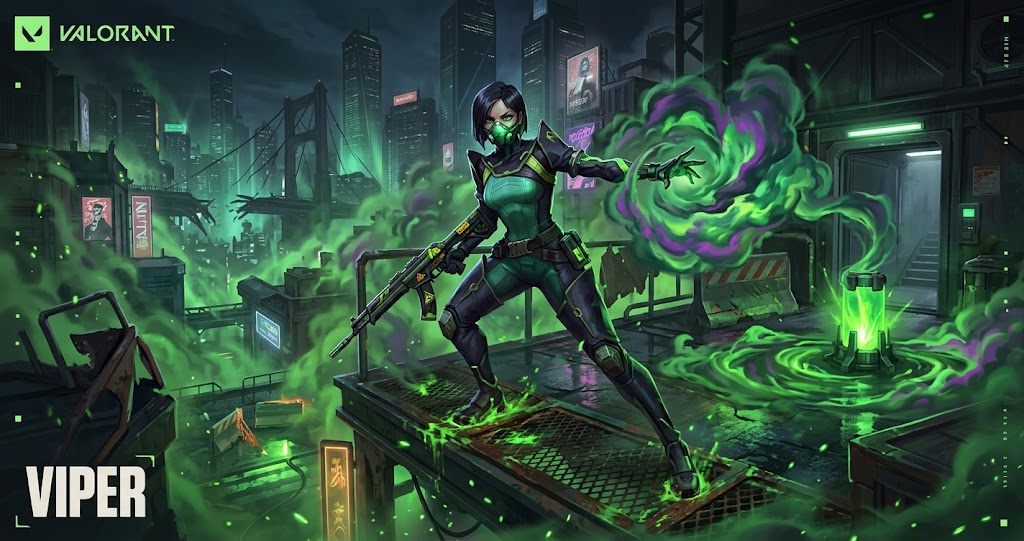
Viper VALORANT players can control space in ways that force enemies to make uncomfortable decisions. Her toxic abilities block vision, weaken opponents, and create powerful opportunities for coordinated attacks or defensive holds.
Whether you are learning Viper for the first time or trying to improve your Controller gameplay, understanding her fuel management and utility timing is essential. This guide explains her abilities, practical strategies, map control approach, common mistakes, and ways to get more value from her kit.
Why Viper VALORANT Players Choose Her
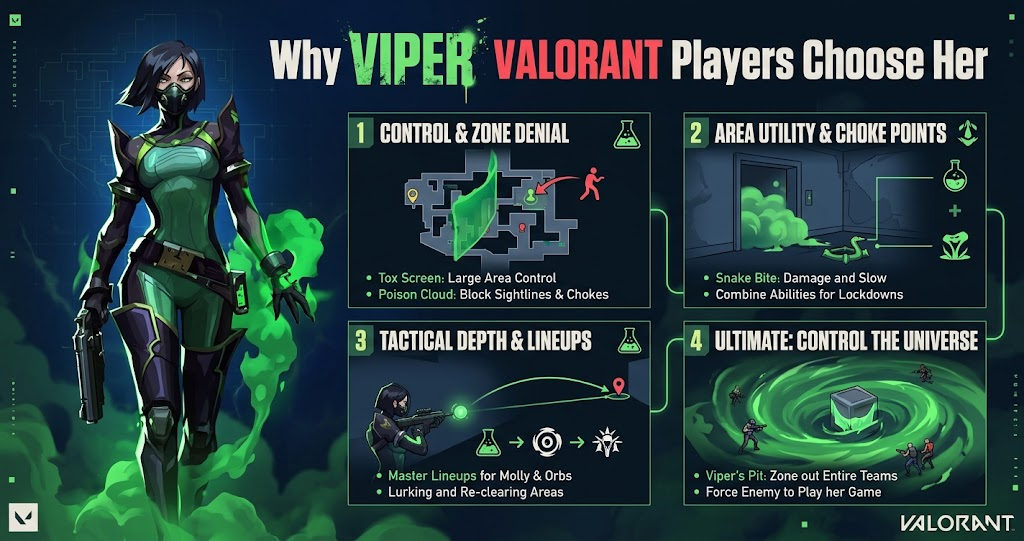
Viper is a Controller built around controlling areas rather than simply placing traditional smokes. Riot describes her as an American Chemist who uses poisonous chemical devices to control the battlefield and restrict enemy vision. Her role remains Controller, making her especially useful when a team needs strong area denial.
Her biggest strength comes from combining vision control with decay. Instead of simply hiding an area, Viper can make opponents think twice before walking through her utility. As a result, enemies may delay an execute, give up space, or enter a site at a disadvantage.
However, Viper requires more planning than some Controllers. Her utility depends heavily on positioning and resource management. A poorly placed wall can reveal your intentions, while careless fuel usage can leave your team without important coverage when the round reaches a critical moment.
Viper Abilities Explained
Viper’s abilities work together rather than functioning as isolated tools. Her wall and smoke create visual barriers, while Snake Bite provides area denial. Her ultimate then gives her a powerful zone where she can create close-range fights on her terms.
Viper Toxic Screen
Toxic Screen is one of the most recognizable parts of Viper’s kit. The wall divides an area and blocks enemy vision, which makes it useful for cutting a site into smaller sections.
The best value comes from placing the wall before enemies can react. On attack, a well-planned Toxic Screen can separate defenders from important angles and create safer paths toward the Spike site. On defense, it can make an enemy execute more difficult by breaking their sightlines.
Placement matters more than simply activating the ability. You should think about what the wall blocks, what it leaves open, and how your teammates can use the resulting space.
Viper Poison Cloud
Poison Cloud provides a flexible toxic smoke that can deny vision around important areas. According to Riot’s current agent information, Viper can deploy the gas emitter and reactivate it to create the toxic cloud while managing her fuel.
This makes Poison Cloud particularly useful around choke points, Spike locations, and common defensive positions. You can also combine it with Toxic Screen to create layered vision denial.
The key is restraint. Activating every piece of utility immediately can reduce your options later. Instead, save the smoke for moments when it can protect a plant, delay a push, or create a favorable fight.
Viper Snake Bite
Snake Bite gives Viper a damaging area-denial tool that can punish enemies who remain in a specific location. It becomes especially valuable around the Spike because opponents must often stand in a predictable area to complete a defuse.
You can also use Snake Bite to discourage aggressive pushes. Rather than throwing it simply because an enemy is nearby, consider what movement the ability can force. A well-timed acid pool can make an opponent move into a teammate’s crosshair or abandon an advantageous position.
Riot has adjusted Snake Bite and Viper’s other abilities several times over VALORANT’s lifespan, showing how important careful balancing has been for her area-control identity.
Viper’s Pit
Viper’s Pit creates a large toxic zone that dramatically changes how players approach a fight. Inside the ultimate, Viper can use reduced visibility and close-range positioning to create difficult engagements.
The ultimate is especially effective when your team has control of the Spike area. Instead of treating it as a tool that must secure kills immediately, think of it as a way to make the enemy’s next decision extremely difficult.
Viper’s Pit can also create psychological pressure. Enemies may hesitate to enter, search for Viper, or waste utility trying to clear the area. That hesitation can give your teammates valuable time.
Viper VALORANT Fuel Management
Fuel management separates strong Viper players from players who activate everything without a plan. Her toxic abilities consume fuel, so keeping your utility active continuously is not always the best decision.
Riot has repeatedly adjusted Viper’s fuel system to create clearer periods of downtime and make resource management more important. One major update reduced her fuel regeneration rate and increased the time needed to fully recover after running empty.
Therefore, avoid treating your fuel bar like an unlimited resource. Activate your smoke when it changes the situation. Once the immediate threat disappears, consider whether keeping the ability active is still providing meaningful value.
This approach becomes even more important during retakes. If your fuel is nearly empty when the enemy begins executing, you may lose access to the utility that could have slowed them down.
Best Viper Strategies for Attack
On attack, Viper should focus on creating uncertainty and giving her team safer routes into contested areas. Toxic Screen can split defensive positions, while Poison Cloud can cover a critical angle or protect a plant.
A strong attack often starts before the round becomes chaotic. Think about where defenders are likely to stand and how your utility can reduce the number of angles your teammates must worry about.
Viper can also fake pressure effectively. A wall in one area may suggest an execute while your team prepares to attack another location. However, the best fakes are believable without wasting too much utility.
After the Spike is planted, preserve your remaining resources whenever possible. Your utility can become more valuable during the post-plant than it was during the initial entry.
Best Viper Strategies for Defense
Defense gives Viper more opportunities to control enemy movement. Her wall can divide a site, while Poison Cloud can protect a choke point or make an aggressive push less attractive.
You should avoid using defensive utility automatically at the beginning of every round. Enemy teams can adapt quickly if your setup never changes. Instead, vary your positioning and timing so opponents cannot easily predict your response.
Viper can also delay an execute without taking a fight immediately. A well-timed smoke can force attackers to wait, reposition, or use their own utility before they gain access to the site.
This delay gives your teammates time to rotate. As a result, Viper can create value even when she does not secure a kill herself.
Viper VALORANT Utility Comparison
The following table shows how each major Viper ability generally contributes to a round.
| Ability | Main Purpose | Best Situation | Key Skill |
|---|---|---|---|
| Toxic Screen | Vision denial | Site executes | Placement |
| Poison Cloud | Flexible smoke | Choke points | Timing |
| Snake Bite | Area denial | Plants and defuses | Prediction |
| Viper’s Pit | Zone control | Spike fights | Positioning |
The key takeaway is that each ability solves a different problem. Toxic Screen controls broad sightlines, Poison Cloud provides flexible coverage, Snake Bite punishes predictable positions, and Viper’s Pit can transform a contested area into a dangerous close-range zone.
How to Improve Viper Lineups
Viper lineups can provide useful consistency, but memorizing dozens of throws should not become the entire focus of your gameplay. A lineup only matters when it solves a real tactical problem.
Start with positions that appear frequently in your matches. Learn where your Snake Bite can land for common Spike plants, then practice the throw until you can execute it without spending too much time looking away from the battlefield.
You should also understand the situation behind each lineup. If the enemy changes the plant location, a memorized throw may no longer provide value. Adaptability is more important than performing a perfect setup that no longer matches the round.
Common Viper Mistakes to Avoid
One common mistake is activating Toxic Screen and Poison Cloud without considering fuel. Using both together can consume resources quickly, and Riot has previously increased fuel drain when both abilities were active.
Another problem is predictable utility. If you use the same wall placement and timing every round, opponents can prepare for it. Changing your setups forces enemies to gather information rather than simply following a practiced response.
Some players also become too focused on lineups. Viper is still a gunfight-focused VALORANT agent. Utility should make your fights easier, not replace good positioning, crosshair placement, and communication.
Finally, avoid playing too far away from your team without a reason. Viper can provide value from unusual positions, but her utility becomes stronger when teammates can capitalize on the space she creates.
Viper on Different Team Compositions
Viper works particularly well when teammates can take advantage of the space she creates. Duelists can use blocked sightlines to enter contested areas, while Initiators can combine information or crowd-control abilities with her toxic utility.
Her value also increases when the team understands her timing. A wall means little if teammates enter before it provides useful coverage. Likewise, a Snake Bite becomes much stronger when another player can capitalize on the enemy’s forced movement.
Communication therefore matters. Even a simple call before activating Toxic Screen can prevent teammates from misunderstanding the intended route.
Is Viper Still Worth Learning?
Viper remains a distinctive Controller because her utility asks players to think about timing, space, and resource management together. Riot has adjusted her abilities across multiple updates, often focusing on reducing excessive stall potential while preserving her unique identity.
That makes her a rewarding choice for players who enjoy strategic gameplay. She may not feel as straightforward as a traditional smoke Controller, but mastering her setups can give you more ways to influence a round.
If you enjoy controlling enemy movement and creating favorable fights for your team, Viper is worth learning. Focus first on fundamentals, then add advanced lineups and map-specific setups as your confidence improves.
Conclusion
Viper VALORANT gameplay rewards planning, patience, and smart resource management. Her Toxic Screen and Poison Cloud can reshape sightlines, Snake Bite can punish predictable positions, and Viper’s Pit can turn an important area into a difficult fight for the enemy.
The biggest improvement comes from using utility with purpose rather than automatically activating everything. Learn the maps, communicate your plans, manage your fuel, and adapt your setups when opponents recognize your patterns.
FAQs
What role is Viper in VALORANT?
Viper is a Controller in VALORANT. Her kit focuses on vision denial, area control, decay, and creating difficult situations for enemies. She can support attacks, defend sites, delay pushes, and control post-plant situations through careful use of her toxic abilities.
Is Viper difficult to play?
Viper can be more demanding than straightforward Controllers because players need to manage fuel and plan utility placement. However, beginners can learn her effectively by starting with basic wall and smoke placements. Once those become comfortable, advanced lineups and mind games are easier to add.
What is Viper’s strongest ability?
Viper’s strongest ability depends on the situation. Toxic Screen can control major sightlines, while Viper’s Pit can dominate an important area during a Spike fight. Poison Cloud and Snake Bite become especially powerful when combined with good timing and team coordination.
Should Viper save her utility for post-plant?
Saving some utility for post-plant can be extremely valuable, especially when your team has limited control of the Spike area. However, you should not refuse to use utility during the execute simply to preserve it. The best approach is to spend resources when they create meaningful advantages.
Are Viper lineups necessary?
Viper lineups are useful, but they are not required to become a strong player. Understanding positioning, timing, fuel management, communication, and gunplay should come first. After learning those fundamentals, a few reliable lineups for common situations can make your utility more consistent.
For more updates visit: GAME ARENAX
