



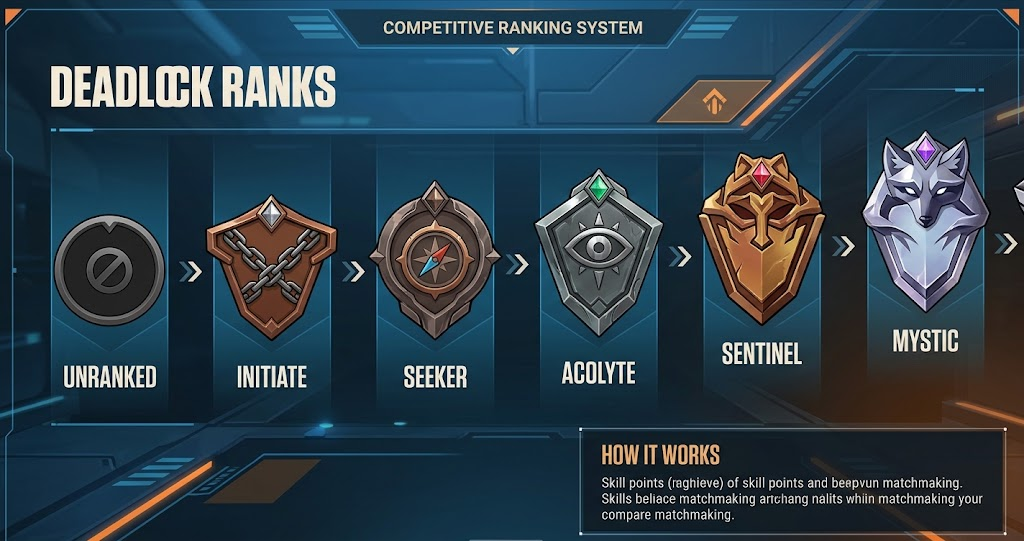
Want to know where you stand in Deadlock’s competitive ladder? Understanding Deadlock ranks helps you track your progress, prepare for tougher matches, and set realistic goals as you improve. The game uses its own rank names rather than the familiar Bronze, Silver, and Gold system found in many other competitive games.
This guide explains every rank in order, how subranks work, how to access Ranked Mode, and what you can do to climb more consistently. It also covers placement matches, rank points, and common mistakes that can slow your progress.
What Are Deadlock Ranks?
Deadlock is a team-based multiplayer game from Valve that combines hero abilities, shooting, and lane-based objectives. Its ranked system gives players a visible badge that reflects their competitive standing.
The current system has eleven named ranks, starting with Initiate and ending with Eternus. Before completing calibration, players appear as Obscurus, which represents an unranked state rather than a regular competitive tier. Each named rank has six subranks, from I through VI.
Ranked Mode separates competitive progression from Standard Mode. This means you can practice, learn heroes, and play more casually in Standard Mode without directly changing your ranked badge. Ranked matches, meanwhile, contribute to your visible competitive progress.
Because Deadlock is still evolving, details such as season dates and matchmaking rules can change. Always check the current in-game Ranked hub or official patch notes before relying on older guides.
Deadlock Ranks in Order From Lowest to Highest

The rank names can feel unfamiliar at first. However, once you learn their order, it becomes easier to understand your position and the next milestone you need to reach.
The table below shows the current Deadlock rank ladder, from the initial uncalibrated state to the highest competitive rank.
| Order | Rank | Subranks | Meaning |
|---|---|---|---|
| Unranked | Obscurus | None | Calibration incomplete |
| 1 | Initiate | I to VI | First named rank |
| 2 | Seeker | I to VI | Early progression |
| 3 | Acolyte | I to VI | Developing skill |
| 4 | Sentinel | I to VI | Intermediate progression |
| 5 | Mystic | I to VI | Mid-ladder advancement |
| 6 | Ritualist | I to VI | Higher competitive tier |
| 7 | Emissary | I to VI | Advanced progression |
| 8 | Oracle | I to VI | High competitive tier |
| 9 | Phantom | I to VI | Elite progression |
| 10 | Ascendant | I to VI | Near the top |
| 11 | Eternus | I to VI | Highest named rank |
Obscurus does not count as one of the eleven named ranks. Once calibration is complete, your displayed rank places you on the competitive ladder. Eternus sits at the top, while the subrank shows your progress within the current tier.
How Deadlock Subranks Work
Every named rank contains six subranks, labeled I, II, III, IV, V, and VI. Subrank I is the starting point of a tier, while VI is its highest step.
For example, a player progressing through Mystic will move from Mystic I toward Mystic VI before advancing to Ritualist I. This structure provides smaller milestones between the major rank names.
Most subrank promotions require rank points earned through matches. The final step between named ranks can require more progress than an ordinary subrank promotion. At Eternus, progression uses dynamically adjusted thresholds rather than a fixed point target for every subrank.
Therefore, do not judge your progress only by wins and losses. Pay attention to the rank-point changes shown after each match, since the matchmaker may award different amounts depending on the game and its expectations.
How to Unlock Deadlock Ranked Mode
Ranked Mode has entry requirements, so new players should prepare before expecting to see their first competitive rank. Under the current system, players need 60 wins in Standard Mode and must have at least three heroes with 15 Standard Mode wins each to qualify for Ranked.
These requirements encourage players to build experience with multiple heroes before entering competitive matches. As a result, you should use Standard Mode to learn different roles, practice abilities, and understand how objectives work.
Once eligible, open the Ranked option in the game and follow the available instructions. Ranked play currently supports solo or duo queues, with restrictions on how far apart teammates can be in rank. Calibration matches must also be played solo.
What Are Calibration Matches?
Calibration determines your initial placement in the current ranked season. The current system uses eight calibration games, during which the matchmaker evaluates your results and previous performance to establish an appropriate starting point.
You cannot enter calibration with a party, so prepare to play independently during these matches. Focus on making reliable decisions rather than chasing impressive statistics. Team coordination, objective control, and consistent performance can all contribute to stronger results.
Calibration also has a placement limit. Players cannot finish initial calibration above Oracle VI under the current rules. Therefore, reaching a higher rank requires further progress after placement.
How to Rank Up in Deadlock
Climbing the Deadlock ranks requires more than winning a few matches in a row. Strong fundamentals, flexible hero choices, and good decisions during objectives can help you build more consistent results.
Improve Your Hero Knowledge
Choose a small group of heroes and learn their abilities, strengths, and weaknesses. Understanding your preferred characters helps you make better decisions during fights and reduces mistakes caused by unfamiliar mechanics.
However, avoid relying on only one hero. Ranked eligibility and match selection make a broader hero pool useful. Practicing at least a few suitable picks can help you adapt when another player selects your preferred character.
Focus on Objectives and Team Fights
Kills can create opportunities, but objectives ultimately shape the match. Pay attention to lane pressure, map movement, and the timing of team fights. A fight that looks favorable may still be a poor choice if it leaves an important objective undefended.
Communicate with your teammate when possible, and avoid chasing opponents across the map without a clear reason. Consistent decisions often create more value than risky plays that depend on luck.
Review Your Mistakes After Each Match
Instead of blaming matchmaking after a loss, consider what you could change next time. You might have entered a fight without support, stayed in a lane too long, or used an important ability too early.
Look for repeated patterns across several matches. One defeat does not prove that your strategy is wrong, but recurring mistakes can reveal exactly what you need to practice.
What Happens When You Lose Ranked Matches
Losing a ranked match can reduce your rank points and slow your progress toward the next subrank. However, the effect may vary because the matchmaking system can adjust the points awarded or deducted based on its expectations and other factors.
The current system also includes rank-loss protection at certain boundaries. For example, players receive a limited number of protected losses at the start of a full rank or subrank before dropping to the previous tier. The exact protection depends on your position in the ladder.
Consequently, one loss does not always mean an immediate demotion. Still, avoid treating protection as a reason to play carelessly. Use each match to improve your decisions and maintain steady progress.
Conclusion
The Deadlock ranks system gives competitive players a clear path from Initiate to Eternus, with six subranks inside each named tier. Learning how calibration, rank points, and matchmaking work helps you set realistic goals and understand your progress.
To climb, focus on a few heroes, prioritize objectives, communicate with teammates, and review repeated mistakes after each match. Most importantly, keep practicing instead of chasing short-term wins.
FAQs
How many ranks are there in Deadlock?
Deadlock has eleven named competitive ranks, from Initiate to Eternus. Obscurus represents the uncalibrated state before a player receives a regular rank. Each named rank contains six subranks, labeled I through VI, which provide smaller steps of progression within the ladder.
What is the highest rank in Deadlock?
Eternus is the highest named rank in Deadlock’s current ranked system. It contains six subranks, and the top end uses dynamically adjusted thresholds. Reaching Eternus requires sustained competitive performance, strong game knowledge, and consistent results against other skilled players.
How do I unlock Ranked Mode in Deadlock?
Under the current rules, you need 60 wins in Standard Mode and at least three heroes with 15 Standard Mode wins each. Once you meet these requirements, you can access Ranked Mode. Check the in-game requirements in case a future update changes eligibility.
How many calibration matches does Deadlock have?
The current system uses eight calibration matches to determine your initial placement for a ranked season. You must play these matches solo, and the system considers your performance when assigning your starting rank. Calibration currently has a maximum placement of Oracle VI.
Can I play Deadlock ranked with friends?
Yes, Ranked Mode currently supports solo and duo queues. Duo partners must meet the game’s rank-distance requirements, while Eternus players face a specific restriction on which Eternus subranks they can queue with. Standard Mode offers more flexible party options for casual play.
For more updates visit: GAME ARENAX
