



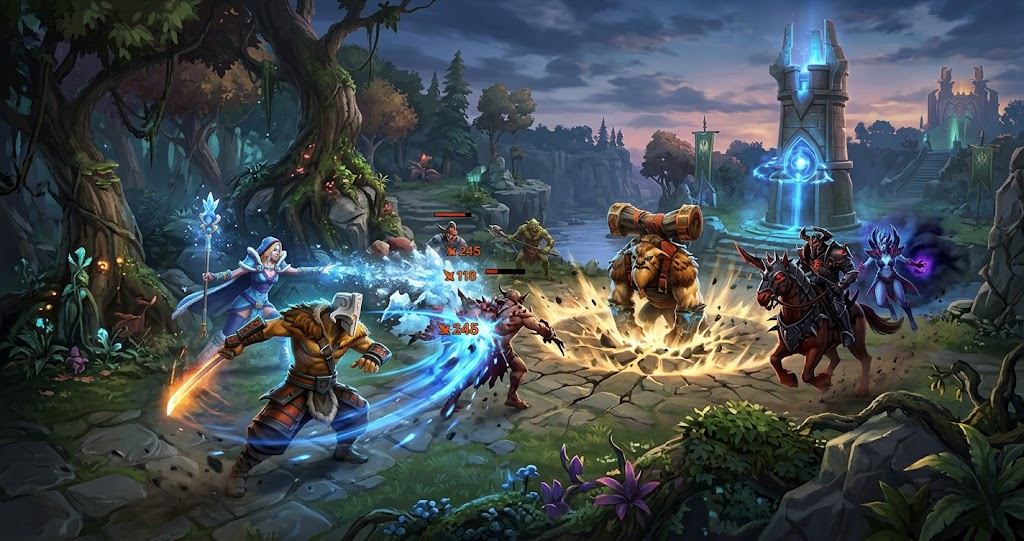
Dota 2 is a competitive strategy game where every decision can change the outcome of a match. Its unique heroes, tactical team fights, and deep item system create an experience that rewards both quick thinking and long-term planning. Whether you are new to multiplayer online battle arena games or returning after a break, understanding its mechanics can help you play with greater confidence.
This guide explains how Dota 2 works, which roles players can choose, how its heroes and items shape matches, and what beginners should learn first.
What Is Dota 2?
Dota 2 is a free-to-play multiplayer online battle arena game developed and published by Valve. Two teams compete on a shared map, with five players on each side. Each player controls a hero with unique abilities, strengths, and weaknesses.
The main objective is to destroy the opposing team’s Ancient, a structure located inside its base. However, reaching that objective requires more than winning individual fights. Teams must manage resources, defend important structures, control map areas, and coordinate their attacks.
Dota 2 stands out because it offers many ways to approach the same match. One team might focus on early aggression, while another builds strength for the late game. Consequently, adapting to opponents often matters as much as executing a planned strategy.
The game is available on PC through Steam. Since it uses a free-to-play model, players can begin without purchasing the base game. Its competitive depth also makes it popular among players who enjoy mastering complicated systems over time.
How Dota 2 Gameplay Works
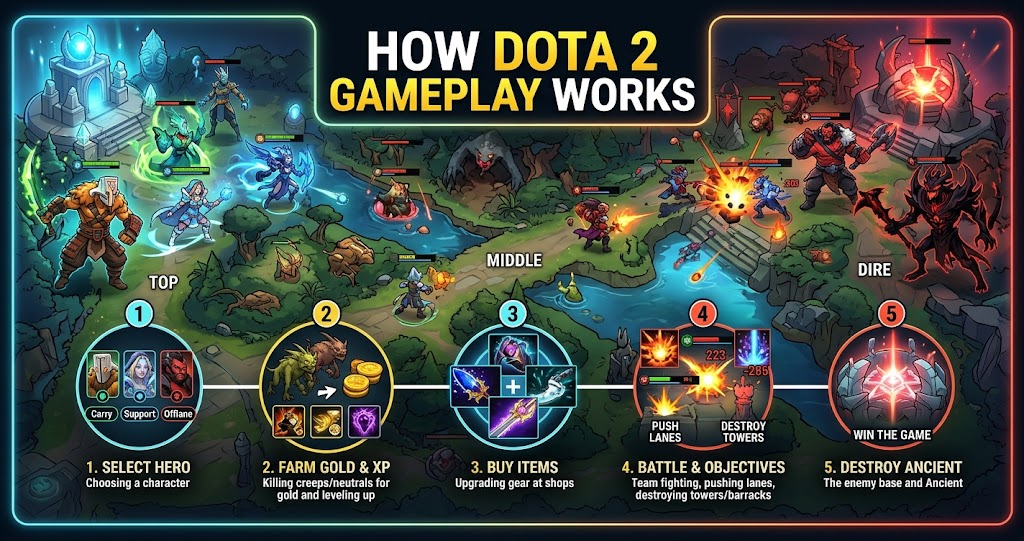
A typical Dota 2 match begins with players selecting heroes and preparing for the battle ahead. Once the match starts, teams earn gold and experience by defeating enemy units, fighting heroes, and completing other in-game objectives.
Gold allows players to purchase items that improve their heroes or provide useful abilities. Experience increases a hero’s level, unlocking stronger skills and improving its effectiveness. Therefore, collecting resources efficiently can create a significant advantage.
Understanding the Dota 2 Map
The map connects both bases through three main lanes: top, middle, and bottom. Each lane contains defensive towers, while waves of controlled units, commonly called creeps, move toward the opposing base.
Between these lanes lies the jungle, which contains neutral creeps and opportunities to collect additional resources. Players must balance farming with helping teammates because spending too much time in one area can leave important objectives unprotected.
The map also contains strategic locations that teams contest throughout a match. Controlling these areas can improve vision, create opportunities for attacks, and make it safer to move around the battlefield.
Destroying Towers and the Ancient
Towers protect key paths toward each team’s base. Teams generally need to break through defensive structures before they can threaten the Ancient directly.
However, attacking without preparation can be dangerous. Opponents may defend together, use powerful abilities, or punish players who move too far from their teammates. Successful pushes usually combine good timing, suitable items, and coordinated pressure.
Dota 2 Heroes and Their Abilities
Heroes are the foundation of every match. Each one has a distinct set of abilities that determines its preferred playstyle, strengths, and contribution to the team.
Some heroes specialize in dealing heavy damage, while others protect allies, disable opponents, or control important areas. For example, Crystal Maiden offers magical support and crowd control, while Juggernaut combines physical attacks with abilities that support aggressive fighting.
Choosing a Hero as a Beginner
New players should start with heroes whose abilities are straightforward to understand. A simpler hero lets you focus on map awareness, resource management, and positioning instead of learning several complicated mechanics simultaneously.
Wraith King can be a useful starting point because his kit offers a relatively direct approach to combat. Lich is another option for players who prefer supporting teammates with spells and defensive tools.
Nevertheless, a beginner-friendly hero does not automatically guarantee success. Learning when to engage, when to retreat, and how to use abilities effectively remains essential. Try different heroes in practice matches before committing to a preferred role.
How Hero Counters Affect Matches
Every hero has situations where it performs well and others where it struggles. Some characters rely on mobility, while others depend on channeling spells or remaining close to their targets.
As a result, drafting matters. A team with reliable disables may have an advantage against mobile enemies, while heroes with strong area damage can punish opponents who group together. Understanding these interactions helps players make better decisions during hero selection.
Dota 2 Roles Explained
Team composition matters because five players cannot all perform the same job effectively. Dota 2 uses a position system that generally describes how players prioritize farm and resources.
The table below explains the five traditional positions and their common responsibilities.
| Position | Common Role | Main Priority | Typical Contribution |
|---|---|---|---|
| Position 1 | Carry | High farm priority | Stronger late-game damage |
| Position 2 | Midlaner | High farm priority | Levels and map pressure |
| Position 3 | Offlaner | Independent farm | Initiation and durability |
| Position 4 | Soft support | Shared resources | Roaming and playmaking |
| Position 5 | Hard support | Lowest farm priority | Vision and team protection |
These positions describe common responsibilities rather than strict rules. Hero choices and strategies can change depending on the match, and players sometimes experiment with unconventional combinations.
Carry and Midlane Strategies
The carry usually focuses on collecting gold and experience to become more effective later in the game. This role requires careful farming, awareness of enemy movements, and good judgment about when to join fights.
Meanwhile, the midlaner often gains experience quickly by playing in the middle lane. That advantage can create opportunities to assist other lanes, secure objectives, or pressure vulnerable opponents.
Support and Offlane Responsibilities
Supports help their teammates by providing vision, controlling opponents, and protecting important heroes. They may also create opportunities for attacks through disables and well-timed rotations.
The offlaner often disrupts the opposing carry while building items that help the team survive or start fights. Therefore, a strong offlaner can create space for teammates even without collecting the most gold.
Dota 2 Items and Strategic Decisions
Items can change how a hero performs throughout a match. Some provide additional damage or durability, while others offer mobility, healing, or abilities that influence team fights.
For example, Blink Dagger helps suitable heroes initiate fights or reposition quickly. Black King Bar provides temporary protection against many forms of magical damage and disabling effects, although its exact usefulness depends on the enemy lineup and game conditions.
Players should avoid copying item builds without considering the match. An item that works well against one lineup may offer little value against another. Instead, examine the threats on the opposing team and choose equipment that addresses the most important problems.
Gold management also matters. Spending every available resource immediately can leave a hero without the item needed for an upcoming fight. Likewise, saving for a major purchase may be worthwhile, but only when the delay does not create an avoidable disadvantage.
Dota 2 Game Modes and Ranked Matches
Dota 2 offers different ways to experience its competitive systems. Standard matchmaking allows players to practice against other people, while ranked matchmaking provides a structured environment for measuring competitive progress.
Newcomers should prioritize learning the fundamentals before worrying about rank. Unranked matches provide opportunities to explore unfamiliar heroes, experiment with item builds, and understand how team fights develop.
The game also includes modes that change how players approach hero selection or match structure. Availability and details can change as Valve updates the game, so check the current in-game menu for the options offered in your region.
Ranked play rewards consistency, but a single match rarely tells the whole story. Improving positioning, decision-making, communication, and resource management can deliver more lasting benefits than focusing only on short-term results.
Beginner Tips for Better Dota 2 Matches
The most useful early habit is to watch the minimap regularly. It helps you identify missing opponents, recognize potential ambushes, and decide when a lane has become unsafe. Even a mechanically strong player can lose an advantage by ignoring information from the map.
Next, practice last-hitting creeps to earn gold efficiently. Missing too many last hits can delay important purchases, making later fights harder. However, farming should never become an excuse to ignore teammates when they need immediate assistance.
Communication is equally important. Use pings and concise messages to share useful information, especially when an enemy disappears or your team wants to attack an objective. Cooperative decisions often create better opportunities than chasing individual kills.
Finally, review your mistakes after difficult matches. Consider whether poor positioning, an unnecessary fight, or a delayed item purchase contributed to the result. Dota 2 has a steep learning curve, but small improvements become valuable when repeated across many games.
Is Dota 2 Worth Playing in 2026?
Dota 2 remains a compelling choice for players who enjoy strategic multiplayer competition. Its extensive hero selection, flexible item builds, and emphasis on teamwork create considerable depth for anyone willing to learn its systems.
The main drawback is its learning curve. Beginners may struggle with unfamiliar abilities, complex interactions, and the amount of information available during a match. However, practicing one role and a small selection of heroes makes the experience easier to manage.
Its free-to-play model also makes it accessible to PC players who want to try a competitive MOBA without buying the base game. Players interested in esports can additionally explore professional matches to observe drafting decisions, rotations, and coordinated team fights.
Conclusion
Dota 2 combines deep strategy, distinctive heroes, tactical item choices, and competitive team play in a challenging multiplayer experience. Learning its lanes, roles, and objectives provides a strong foundation for understanding why every decision matters.
If you are new to the game, start with a straightforward hero, practice last-hitting, and develop your map awareness before focusing on ranked matches. Visit the official Dota 2 resources for game information, then jump into a match and begin building your skills.
FAQs
Is Dota 2 free to play?
Yes, Dota 2 is free to play on PC through Steam. Players can access the core game without purchasing a paid base-game edition. Optional purchases may be available for cosmetic items and other content, but the fundamental gameplay experience does not require buying heroes individually.
Is Dota 2 difficult for beginners?
Dota 2 can be challenging because players must learn hero abilities, item builds, map awareness, and team strategy. However, beginners can make steady progress by practicing a few straightforward heroes, learning one role, and focusing on fundamentals before entering ranked matches.
How many players are on a Dota 2 team?
Each standard Dota 2 team has five players, creating a ten-player match. Every player controls a different hero and contributes through roles such as carry, midlaner, offlaner, or support. Team coordination helps players control objectives and work toward destroying the opposing Ancient.
What is the main objective in Dota 2?
The main objective is to destroy the enemy Ancient while protecting your own. Teams must fight opponents, collect resources, and break through defensive structures to reach the enemy base. Winning individual battles helps, but coordinated pushes and good objective decisions ultimately determine the match.
Can you play Dota 2 solo?
Yes, you can queue for matches alone. Matchmaking places you with other players, although coordination and communication remain important. Playing solo can help you develop individual skills, but learning to cooperate with teammates is essential because Dota 2 rewards team strategy rather than isolated performance.
For more updates visit: GAME ARENAX
