



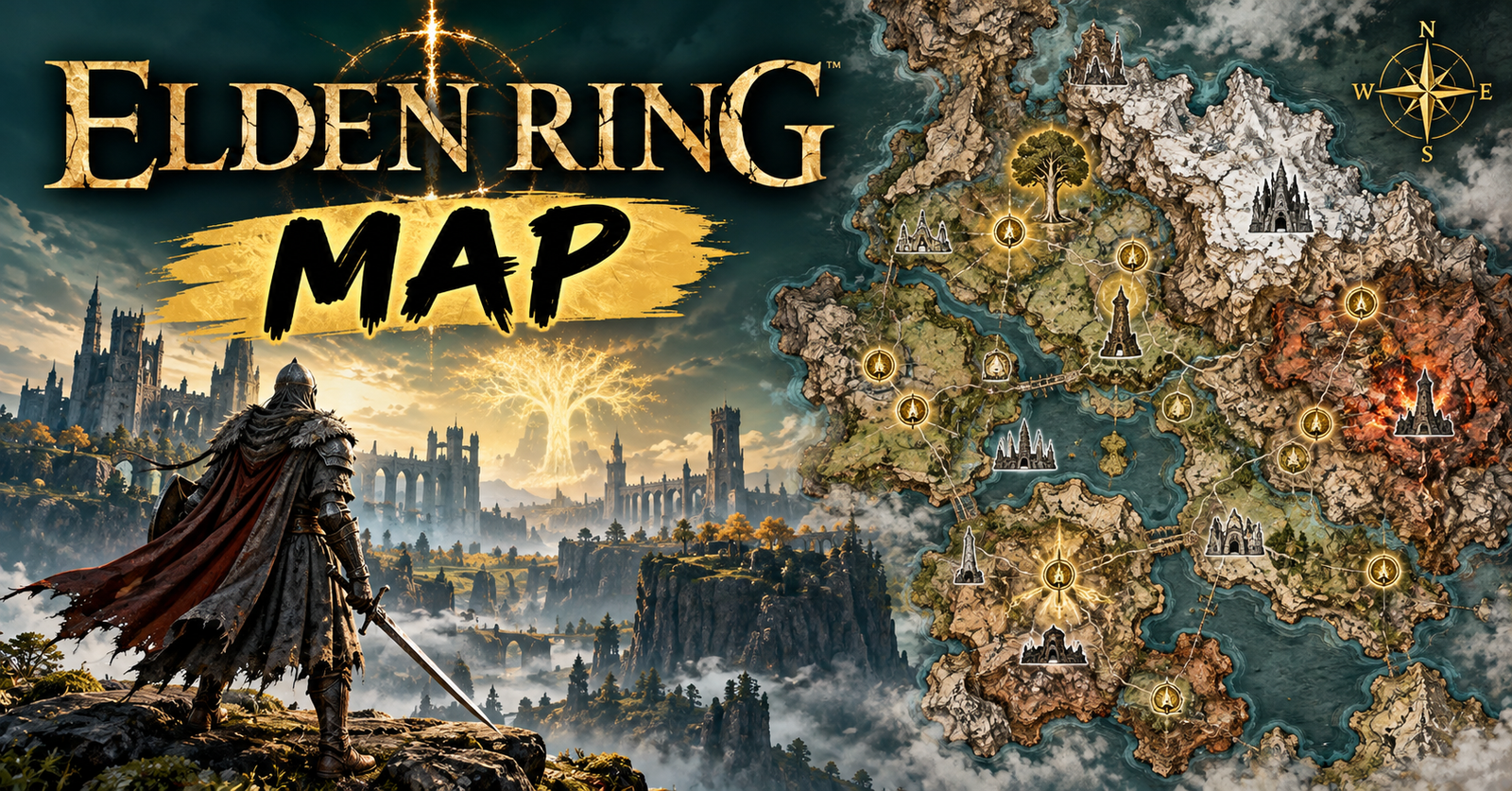
The Elden Ring map can feel overwhelming when you first step into the Lands Between. The world is huge, paths often lead somewhere unexpected, and important locations can remain hidden until you explore carefully.
A good map makes that journey much easier. This guide explains how the map works, where the major regions connect, how map fragments reveal unexplored areas, and what to look for when exploring dungeons, ruins, caves, and major landmarks.
How the Elden Ring Map Works
Elden Ring uses an open-world map that gradually becomes clearer as you explore. When you first enter a new area, much of the map appears as an empty brown landscape with limited geographic detail.
However, the map is not truly blank. You can often see faint outlines that hint at roads, rivers, mountains, and other terrain. These clues help you locate the map fragment for that particular region.
Map fragments are especially important because they reveal detailed geography. Once you collect one, roads and terrain become much easier to recognize. As a result, exploration becomes less about wandering randomly and more about choosing a direction with a clear purpose.
The map also becomes more useful as you discover Sites of Grace. These locations help you understand where you have already traveled and provide convenient reference points for future journeys.
Elden Ring Map Regions Explained

The Lands Between contains several major regions, and each has its own terrain, enemies, landmarks, and progression challenges. Your route does not always need to follow a strict order, which is one reason the world can feel so open.
Limgrave is the natural starting region for most players. It contains the Church of Elleh, Gatefront, Stormhill, Mistwood, and the route toward Stormveil Castle. Its varied terrain makes it an excellent place to learn how exploration works.
Liurnia of the Lakes sits beyond Stormveil and offers a dramatically different environment. Much of the region is covered by shallow water, while cliffs, academies, ruins, and hidden paths surround the lake.
Caelid lies to the east of Limgrave. Its red landscape immediately signals that the area can be dangerous. Players can find major landmarks such as Sellia and Redmane Castle while exploring the region.
The Altus Plateau provides another major step in exploration. Its golden landscape connects several important areas and eventually leads toward Leyndell, Royal Capital.
The eastern and northern parts of the world become increasingly challenging. Mountaintops of the Giants, Consecrated Snowfield, and the regions beyond them contain tougher enemies and important late-game locations.
Finding Elden Ring Map Fragments
Map fragments are the key to turning an unclear section of the world into a useful navigation tool. Each fragment corresponds to a particular area and reveals its roads, terrain, and major geographic features.
When searching for a fragment, look for a distinctive stone monument on the road or nearby terrain. The monument symbol can often be spotted on an unexplored section of the map because it appears within the faint geographic outline.
This is useful because you do not need to explore every corner before understanding the region. Instead, finding the monument gives you a clear objective and makes the surrounding landscape much easier to read.
Map fragments also help when planning longer journeys. Once the terrain is visible, you can identify roads, cliffs, rivers, and other natural barriers before committing to a route.
Elden Ring Map Locations Worth Exploring
The map contains far more than major castles and obvious landmarks. Some of the most valuable discoveries are tucked away in caves, catacombs, tunnels, ruins, towers, and underground areas.
Stormveil Castle is one of the earliest major locations and introduces players to the game’s complex level design. The castle has multiple routes, hidden areas, valuable items, and difficult encounters.
Raya Lucaria Academy dominates part of Liurnia and serves as one of the region’s most recognizable landmarks. Its surrounding area also contains smaller locations that are easy to miss if you only follow the main road.
In Caelid, Redmane Castle and Sellia provide very different exploration experiences. The region also contains dangerous terrain and enemies that can punish players who arrive too early.
Leyndell is another major landmark. Its enormous structure makes it difficult to understand from a simple glance at the world map. Once inside, however, players can discover interconnected streets, buildings, underground routes, and hidden passages.
Exploration also extends below the surface. Areas such as the Siofra River and other underground regions have their own environments and navigation challenges. These locations are especially important because they can feel disconnected from the surface world at first.
Elden Ring Map and Exploration Routes
A useful approach is to treat the map as a planning tool rather than simply a picture of the world. When you reach a new area, first identify the main roads and nearby Sites of Grace. Then look for paths that lead toward unexplored landmarks.
Roads are usually useful starting points, but they are not the only routes available. Elden Ring frequently rewards players for leaving the obvious path. A cliff may hide a narrow passage, while a ruined structure can contain a staircase or doorway leading somewhere unexpected.
The map also helps you recognize natural barriers. Large cliffs, water, mountains, and sealed entrances can explain why a destination seems close but remains difficult to reach.
Therefore, if a location looks nearby but you cannot find a direct route, check the surrounding terrain instead of repeatedly riding toward the same obstacle. The correct path may begin several minutes away.
Elden Ring Map Features and Their Uses
The world map becomes increasingly useful as you add your own knowledge to it. Markers can help you remember locations that deserve another visit, while discovered Sites of Grace provide convenient travel points.
The following table summarizes some of the most useful map-related elements and what they tell you during exploration.
| Map Element | Main Purpose | Best Use |
|---|---|---|
| Map Fragment | Reveals regional geography | Understanding terrain |
| Site of Grace | Fast travel and rest point | Planning routes |
| Map Marker | Personal reminder | Tracking locations |
| Road | Shows common travel routes | Moving between areas |
| Landmark | Identifies major locations | Finding objectives |
| Cave Entrance | Leads to hidden areas | Exploring optional content |
The main takeaway is that no single map feature tells you everything. Map fragments reveal geography, Sites of Grace support fast travel, and personal markers help you remember discoveries. Together, they make the world much easier to navigate.
Using the Map to Find Dungeons and Hidden Areas
Some of the best content in Elden Ring does not appear as an obvious destination. Caves and catacombs can blend into cliffs, while mines and tunnels may sit beside paths that look unimportant.
Pay attention to the environment when exploring. Strange structures, statues, cliffs, ruined entrances, and suspicious dead ends can indicate that a hidden area is nearby.
Caves are particularly valuable because they often contain crafting materials, equipment, enemies, and bosses. Catacombs can also provide useful rewards while introducing traps and environmental challenges.
Tunnels are different because they commonly focus on mining resources and underground combat. They can be especially useful when you need materials for upgrading weapons.
Because these locations are easy to overlook, it is worth checking areas around major roads rather than following the road itself from beginning to end.
Elden Ring Map and Boss Locations
Boss encounters are spread throughout the world, and not every boss belongs to the main progression. Some major enemies guard critical paths, while others appear inside optional caves, catacombs, ruins, or isolated areas.
The map can help you understand which areas deserve further exploration. However, you should not assume that every unexplored location contains a major boss. Elden Ring uses optional encounters to make exploration feel rewarding even when the destination is not essential.
Major story locations generally provide stronger clues about progression. Optional areas, meanwhile, often reward curiosity with weapons, spells, summons, talismans, upgrade materials, or unique encounters.
If you are searching for a specific boss, using the region’s geography is often more effective than simply traveling randomly. Start from known landmarks and examine nearby paths, underground entrances, and structures.
How to Read the Lands Between Map Better
The map becomes easier to understand once you recognize how FromSoftware uses geography to guide exploration. Roads frequently connect important locations, while major cliffs and mountains divide regions naturally.
You can also use the map’s elevation clues. A destination may appear close horizontally but remain inaccessible because of a large vertical difference. In those situations, search for a route that approaches the location from another direction.
Rivers and lakes work in a similar way. They can create natural barriers while also pointing toward important areas. Bridges, narrow crossings, and surrounding roads often reveal the intended route.
Meanwhile, some locations require more than ordinary exploration. Certain areas become accessible after progressing through quests, defeating specific enemies, or discovering alternative paths.
For a detailed exploration project, [internal link: Elden Ring bosses guide] would fit naturally here. A related [internal link: Elden Ring weapons guide] could also help readers who want to understand what rewards are worth collecting during exploration.
For authoritative information about the game’s mechanics and locations, an outbound reference to the official Elden Ring publisher or developer information page is appropriate. A second useful source would be a reputable gaming reference database that documents locations and game mechanics.
Elden Ring Map for New Players
New players should avoid trying to uncover the entire map immediately. The game is designed around gradual discovery, and rushing toward distant areas can create unnecessary difficulty.
Instead, explore the region around your current progression point. Collect nearby map fragments, activate Sites of Grace, and investigate landmarks that appear along the way.
It is also useful to revisit earlier areas after gaining stronger equipment or new movement abilities. A location that seemed inaccessible before may become easy to reach later.
Most importantly, do not treat the map as a checklist. Elden Ring is built around curiosity. The best discoveries often happen when you notice something unusual and decide to investigate it.
Elden Ring Map for Finding Hidden Content
The world map becomes particularly valuable when you want to find content beyond the main story. Hidden caves, optional bosses, quest locations, and underground regions can dramatically expand your playthrough.
Markers are useful for this purpose because they let you record places that you want to investigate later. For example, you might mark a sealed entrance, an unexplained structure, or a location connected to an unfinished quest.
However, avoid placing too many markers without a clear purpose. A crowded map can become difficult to read. Use simple reminders that tell you why a location matters.
You can also compare the map with your own exploration history. If an area looks empty but you remember seeing an unusual structure there, return and investigate rather than assuming there is nothing important.
Why the Elden Ring Map Matters
The map is more than a navigation screen. It helps you understand the structure of the Lands Between and gives context to the world around you.
Without map fragments, a large region can look confusing. Once the terrain becomes visible, roads and landmarks create a much clearer sense of direction. This makes exploration more efficient without removing the feeling of discovery.
The best approach is to combine the map with environmental observation. Use the map to plan, but use the world itself to discover what lies beyond the next hill.
Conclusion
The Elden Ring map is one of the most useful tools for understanding the Lands Between. Map fragments reveal regional geography, while Sites of Grace, landmarks, roads, and personal markers help you plan where to go next.
Still, the map should support exploration rather than replace it. Follow visible paths, investigate unusual locations, and return to areas when your character becomes stronger. With that approach, the Lands Between becomes easier to navigate while keeping the sense of discovery that makes Elden Ring special.
FAQs
What is the Elden Ring map?
The Elden Ring map represents the Lands Between and its surrounding regions. It gradually becomes more detailed as you explore and collect map fragments. It shows terrain, roads, landmarks, Sites of Grace, and other useful information that helps you plan travel across the open world.
Where do you find Elden Ring map fragments?
Map fragments are found near stone monuments located throughout the major regions of the Lands Between. On an unexplored section of the map, the monument’s faint symbol can often help you identify where the fragment is located.
Does the Elden Ring map show every location?
No. The map provides important geographic information, but many caves, catacombs, tunnels, hidden entrances, and smaller discoveries require exploration. The game intentionally leaves some content for players to discover through environmental clues.
Can you use the Elden Ring map for fast travel?
Yes. Once you discover Sites of Grace, you can generally use the world map to travel between eligible Sites of Grace. Fast travel makes it much easier to return to earlier regions and explore locations you previously skipped.
What is the best way to explore the Elden Ring map?
Start by collecting the local map fragment and discovering nearby Sites of Grace. Then follow roads while checking nearby ruins, caves, cliffs, and unusual structures. Exploring gradually is usually more effective than trying to uncover the entire world at once.
For more updates visit: GAME ARENAX
