



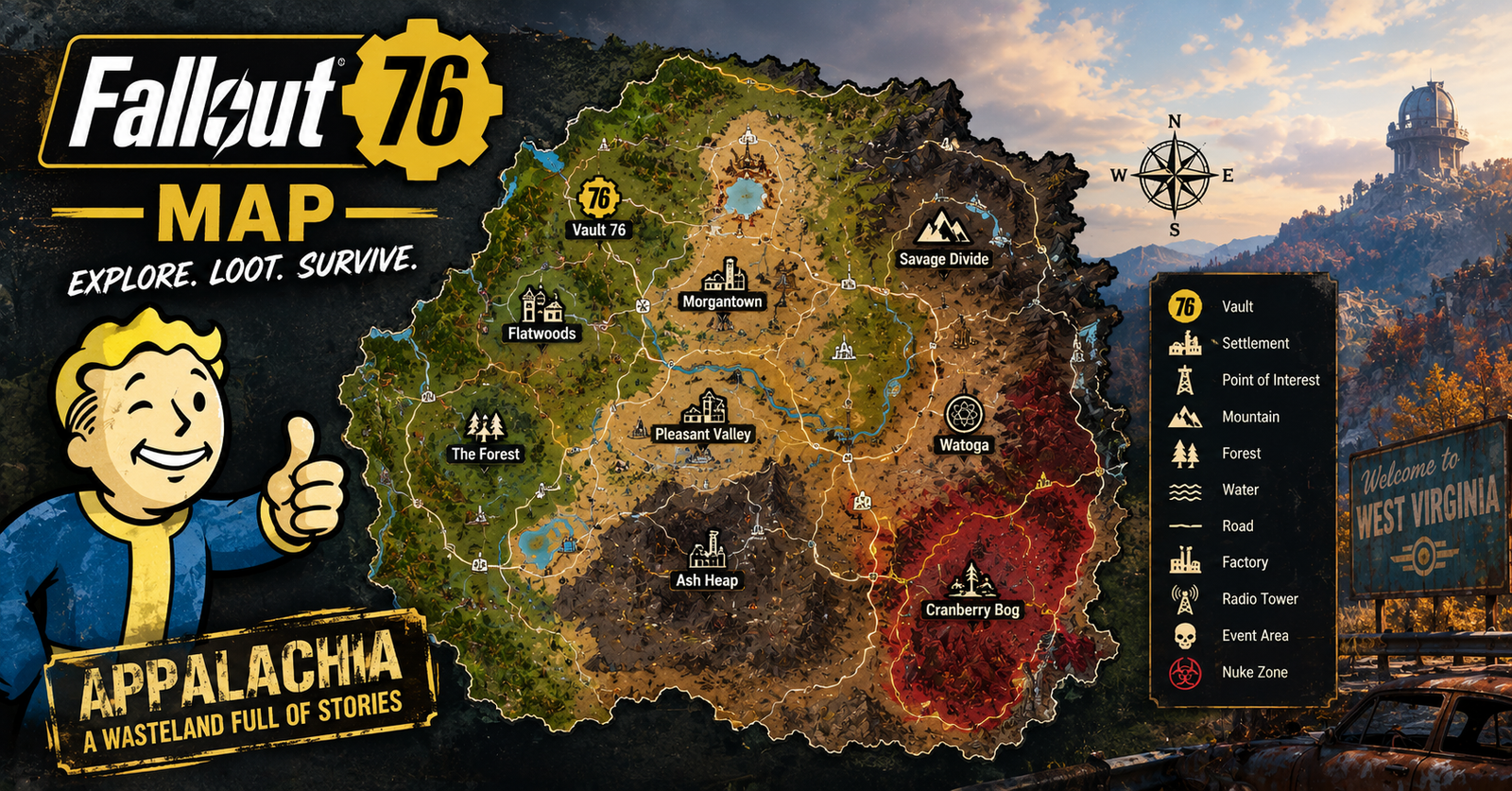
The fallout 76 map is your key to exploring Appalachia, discovering valuable resources, completing quests, and finding locations worth revisiting. However, the world is much easier to navigate when you understand its regions, landmarks, dangerous areas, and fast travel options.
This guide explains how the map works, where to begin your journey, how to use an interactive map, and which exploration strategies help you make better progress. Whether you are a new Vault Dweller or a returning player, these tips will help you explore more efficiently.
How the Fallout 76 Map Works
Fallout 76 takes place in Appalachia, a post-apocalyptic version of West Virginia. Its open world combines forests, industrial ruins, mountain settlements, radioactive wastelands, and abandoned towns. Each area offers different enemies, resources, quests, and exploration opportunities.
Your in-game map helps you track discovered locations and plan journeys across the wasteland. Once you discover a suitable location, its icon appears on your map, allowing you to return later through fast travel when the game permits it.
However, not every useful location becomes obvious immediately. Some buildings contain hidden rooms, while others have underground areas, collectible items, or quest objectives. Therefore, exploring interiors and checking nearby landmarks can reveal more than simply following the main road.
For a broader overview, an interactive Fallout 76 map can help you search for locations and resources without relying entirely on memory. It is especially useful when you need to locate a specific destination or plan a route before leaving your C.A.M.P.
Fallout 76 Map Regions Explained

Appalachia’s original world map contains six major regions: The Forest, Toxic Valley, Ash Heap, Savage Divide, The Mire, and Cranberry Bog. Later content expanded the areas players can explore, including Skyline Valley and the Burning Springs region. Each area offers a different atmosphere and set of challenges.
The Forest: A Good Starting Region
The Forest is a sensible starting point for new players because it offers woodland scenery, settlements, and early quest opportunities. Vault 76 sits in this broader area, making nearby locations useful for learning the game’s basic systems.
Morgantown Airport is worth exploring because it connects to early Responders content. Meanwhile, nearby buildings and roads provide opportunities to collect supplies, discover locations, and improve your equipment before attempting more dangerous journeys. Bethesda’s newcomer guide also recommends spending time in The Forest when quests become too difficult.
Toxic Valley and Ash Heap Industrial Dangers
Toxic Valley features polluted terrain and abandoned settlements. Consequently, players should pay attention to environmental hazards and hostile creatures while searching buildings for useful supplies.
Ash Heap offers a different challenge, with industrial scenery, mining infrastructure, and areas affected by heavy pollution. Both regions reward careful exploration, although players should prepare suitable equipment before spending long periods in dangerous locations.
Savage Divide Mountains and Major Landmarks
Savage Divide crosses the mountainous interior of Appalachia. Its rugged terrain can make travel feel less direct, particularly when cliffs, winding roads, and enemy encounters interrupt your route.
Nevertheless, the region contains important destinations and useful exploration opportunities. Lookout Towers can also help you identify nearby points of interest, so climbing one is worthwhile when you enter an unfamiliar area.
The Mire and Cranberry Bog: More Dangerous Exploration
The Mire features dense vegetation, dark forests, and an unsettling atmosphere. Visibility can be limited, so moving carefully through its waterways and wooded areas helps you avoid unnecessary encounters.
Cranberry Bog offers a different environment, with open stretches, dangerous creatures, and valuable destinations for players who are better equipped. Therefore, it often makes sense to explore safer regions first and return when your weapons, armor, and supplies are stronger.
Fallout 76 Interactive Map Finding Locations Faster
An interactive map can save considerable time when you are searching for a particular building, resource, collectible, or landmark. Instead of wandering across Appalachia, you can search by name or filter locations according to the information provided by the map service.
The Fallout 76 map from Fallout Builds includes discoverable locations and supports searching for resources, enemies, and collectibles. This makes it useful for planning exploration sessions, especially when you have a specific objective.
Another option is the interactive map at Fallout 76 Challenges, which supports searching by location name and filtering by region or type. It also provides challenge-related information for marked locations.
Remember that community maps may differ in their filters, coverage, and update schedules. Therefore, check the map’s available features before relying on it for a particular item or objective.
In-Game Map Versus an Online Map
The in-game map is ideal for checking your current position, reviewing discovered destinations, and making immediate travel decisions. In contrast, an online map is often more convenient for researching a specific collectible or identifying points of interest before entering a region.
The following comparison explains when each option is most useful.
| Map Type | Main Purpose | Best Use | Limitation |
|---|---|---|---|
| In-game map | Navigation | Tracking your journey | Limited search detail |
| Interactive map | Location research | Finding specific targets | Depends on map coverage |
| Region map | Area overview | Planning exploration | May omit small details |
| Resource map | Item discovery | Collecting materials | Locations may require verification |
| Challenge map | Objective planning | Finding challenge locations | Features vary by service |
The best approach is to use both options together. Check an online map to plan your destination, then use the in-game map to manage your route and return to discovered locations.
Best Locations to Explore on the Fallout 76 Map
Certain destinations are particularly useful because they connect to quests, services, exploration, or progression. Their value depends on your current objectives, so it helps to understand why each location matters.
Vault 76 and Morgantown Airport
Vault 76 is the natural starting point for your adventure. From there, follow the early quests and explore nearby settlements instead of rushing into high-risk areas.
Morgantown Airport is another worthwhile destination because of its connection to Responders quests. Search the interior carefully, since useful quest items and plans may not sit directly along the main route. Bethesda specifically highlights the airport’s Small Backpack Plan in its newcomer guide.
The Whitespring Resort and Major Settlements
The Whitespring Resort is a recognizable landmark that players can use as a navigation reference. Other important destinations, including Foundation, The Crater, and Fort Atlas, also help connect exploration with the game’s wider activities.
Fast travel availability and costs depend on the destination and your circumstances. Bethesda notes that players can travel free to certain locations, including their C.A.M.P., teammates, and several prominent settlements. Therefore, learning which destinations offer free travel can help conserve Caps.
Workshops, Resource Areas, and Hidden Spots
Workshops and resource-rich areas can support crafting and material collection. However, the best destination depends on which materials you need and whether enemies or other players create additional risks.
Hidden locations deserve attention as well. Small cabins, abandoned facilities, caves, and interior rooms may contain loot or environmental storytelling that you would miss by traveling directly between quest markers. Explore side paths whenever your supplies and equipment allow it.
Fallout 76 Map Tips for Efficient Exploration
Planning a journey before leaving your current location helps you spend less time backtracking. For example, group nearby quest objectives together and investigate useful landmarks along the route. This approach can help you collect materials while progressing through missions.
You should also activate new locations by visiting them in person. Once a location is discovered, its map icon can make future journeys easier. Lookout Towers provide another useful way to reveal nearby points of interest, although you may still need to visit those places to discover them fully.
Keep your equipment appropriate for the region you intend to visit. Radiation protection, healing supplies, ammunition, and suitable armor can make a significant difference in hazardous areas. If an encounter becomes overwhelming, retreat and return later rather than wasting resources on an unnecessary fight.
For players interested in newer content, it is also worth checking current update notes. For example, Bethesda’s Infestations update introduced changing hostile areas across Appalachia, with the paper map showing the general area rather than the exact location of an infestation. This makes active exploration and teamwork especially useful for finding these encounters.
How to Find Resources and Collectibles
Resource hunting becomes easier when you begin with a clear objective. Decide which crafting material, collectible, or enemy-related item you need, then search an interactive map that supports that category.
Next, check whether the destination is in a region you can handle comfortably. A resource location is less useful if reaching it consumes more ammunition and healing supplies than you can afford. Consequently, combining resource gathering with nearby quests or other objectives can make each journey more productive.
Remember that map markers are guides rather than guarantees that an item will always be available. Enemy activity, game systems, and updates may affect what you encounter. Verify important locations in the game, and consult current official patch notes when an older guide no longer matches your experience.
Conclusion
The fallout 76 map becomes much more useful when you understand its regions, discover important landmarks, and combine in-game navigation with an interactive map. Start in The Forest, explore new destinations at a comfortable pace, and prepare carefully before entering more dangerous areas.
Online maps can also help you locate resources, collectibles, and quest destinations without unnecessary wandering. Open an interactive map, choose your next objective, and start exploring Appalachia with a clearer plan.
FAQs
Is the Fallout 76 map free to use?
Yes. The map included in Fallout 76 is part of the game, and online interactive maps are also available without requiring a separate purchase in many cases. However, individual websites may have their own features, advertising, or usage restrictions, so check the service you choose.
How many regions are in Fallout 76?
The original Appalachia map contains six major regions: The Forest, Toxic Valley, Ash Heap, Savage Divide, The Mire, and Cranberry Bog. Later content added areas such as Skyline Valley and Burning Springs, expanding the destinations available to explore.
What is the best interactive Fallout 76 map?
Fallout Builds and Fallout 76 Challenges both offer interactive maps with location-search features. Fallout Builds is useful for researching locations, enemies, and resources, while Fallout 76 Challenges offers region and category filters. Choose the service that best matches your objective.
How do you unlock locations on the Fallout 76 map?
You generally need to discover locations by visiting them in the game. Once discovered, their icons appear on your map, making it easier to return later. Lookout Towers can reveal nearby points of interest, but some destinations still require a separate visit before they count as discovered.
Can you fast travel anywhere on the Fallout 76 map?
No. Fast travel depends on the destination and the game’s restrictions. It can cost Caps, while certain destinations, such as your C.A.M.P. and teammates, offer free travel under the applicable conditions. Traveling on foot remains necessary when discovering unfamiliar locations and reaching undiscovered objectives.
For more updates visit: GAME ARENAX
