



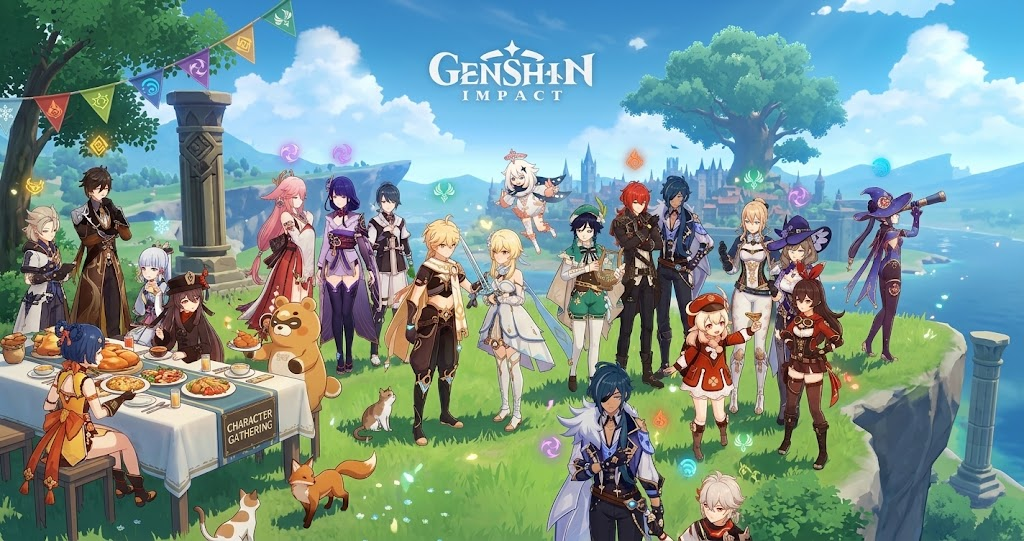
Choosing between the many genshin characters can feel overwhelming, especially when every character has different abilities, elements, weapons, and team roles. A strong character is not always the best choice for every team, because synergy often matters more than individual damage.
This guide explains how Genshin Impact characters work, what separates major roles, and how to build teams around elemental reactions and character abilities. You will also learn how to evaluate a character before investing valuable resources.
Understanding Genshin Characters
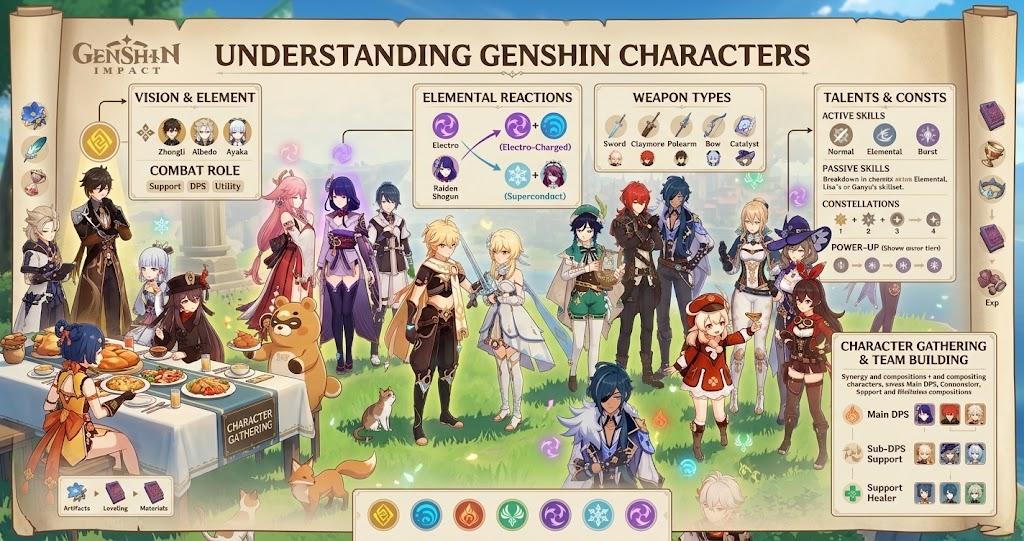
Genshin Impact features a large roster of playable characters, with each one designed around a particular Element, weapon type, and combat style. The seven core Elements are Anemo, Geo, Electro, Dendro, Hydro, Pyro, and Cryo.
Characters also use different weapons. Swords, claymores, polearms, bows, and catalysts each create different combat patterns. As a result, two characters with similar roles can still feel completely different during exploration or combat.
The official Genshin Impact character archive organizes characters by their regions and provides information about their backgrounds and identities. Recent additions have continued expanding the roster across regions such as Fontaine, Natlan, and Nod-Krai.
Genshin Characters and Their Main Roles
Understanding character roles is one of the easiest ways to improve team building. Although some characters can perform several jobs, most are primarily designed around a specific function.
Main DPS Characters
Main DPS characters usually spend more time on the field and deal a large portion of a team’s direct damage. Their rotations often involve using Skills and Bursts before performing Normal, Charged, or Plunging Attacks.
A main DPS works best when teammates can support their damage window. For example, a Hydro character can help enable reactions for a Pyro damage dealer, while an Anemo character may provide crowd control or elemental support.
However, raw damage should not be the only consideration. A character’s attack pattern, energy needs, field time, and reaction compatibility can make a major difference during actual gameplay.
Sub-DPS Characters
Sub-DPS characters contribute damage while spending less time on the field. Their Skills or Bursts may continue dealing damage after the character leaves the battlefield.
This role is particularly useful when building reaction-focused teams. A sub-DPS can apply an element, trigger reactions, or provide additional damage while the main character remains active.
Good team rotations often alternate between these characters instead of keeping every character on the field for the same amount of time.
Support Characters
Support characters improve a team’s performance through healing, shielding, buffs, elemental application, energy generation, or other utility. Some supports can perform several of these functions at once.
A support does not need to deal huge personal damage to be valuable. Keeping teammates alive or improving their damage can have a greater effect on overall team performance.
Genshin Characters With Flexible Roles
Some characters can operate in more than one role depending on their build, weapon, artifacts, and teammates. This flexibility can make them useful when your roster is still developing.
For example, a character may function primarily as a support but contribute meaningful off-field damage. Another may switch between on-field and off-field play depending on the team composition.
That flexibility is worth considering when you have limited resources. A versatile character can fit into more team concepts as your roster grows.
Genshin Characters by Element
Elements are central to Genshin Impact’s combat system. Rather than treating each character independently, players can combine elemental abilities to create reactions.
Hydro, Pyro, Cryo, Electro, Dendro, Anemo, and Geo each interact with the combat system differently. Dendro, for example, created additional team-building possibilities when it was introduced because of its interactions with Hydro, Electro, and Pyro.
Anemo characters can interact with many elements through Swirl and often provide grouping or utility. Geo generally follows a different approach, with teams frequently focusing on Geo damage, shields, and Crystallize-related mechanics.
Why Elemental Synergy Matters
Elemental synergy can determine whether a team feels smooth or frustrating. A powerful character may perform poorly if the rest of the party cannot support their energy, elemental application, or rotation.
For example, reaction-based teams usually need consistent elemental application. Meanwhile, some teams focus more heavily on direct damage and buffs rather than repeatedly triggering reactions.
The important point is that character strength depends heavily on context. A character’s kit should be considered alongside the other three members of the party.
Comparing Common Genshin Character Roles
The table below provides a simple way to understand how major roles typically contribute to a team.
| Character Role | Field Time | Main Purpose | Common Team Value |
|---|---|---|---|
| Main DPS | High | Primary damage | Sustained on-field damage |
| Sub-DPS | Low to Medium | Off-field damage | Extra damage and reactions |
| Support | Low | Buffs, utility, or healing | Team enhancement |
| Shielder | Low | Damage protection | Defensive stability |
| Healer | Low to Medium | Restore HP | Survivability |
| Flexible | Varies | Multiple functions | Adaptability |
The key takeaway is that these roles are not strict categories. Many Genshin characters can combine two or more functions, which is why examining a complete kit is more useful than relying on a simple tier label.
How to Choose the Right Genshin Characters
The best way to choose characters is to start with the team you actually want to play. If you enjoy fast attacks and staying on the field, an on-field damage dealer may suit you. If you prefer switching frequently between characters, an off-field or reaction-focused composition could feel better.
Consider Your Main Damage Source
Start by deciding where most of your damage will come from. Once you choose the central damage dealer, look for characters that improve that character’s elemental application, survivability, energy, or damage output.
This approach prevents a common mistake: building a team around four individually powerful characters who compete for field time.
Check Energy Requirements
Energy Recharge is another important consideration. Some characters rely heavily on their Elemental Burst, so they need enough energy to use it consistently.
If a character frequently has their Burst ready, rotations become much smoother. On the other hand, inconsistent energy can force you to delay abilities and reduce overall team performance.
Think About Rotation Length
A team can look excellent on paper but feel awkward when its rotation takes too long. Characters should generally fit together without creating unnecessary downtime.
For example, if several characters require extended field time, they may compete with one another. A support or sub-DPS with short ability animations can often fit more naturally into the rotation.
Building Teams With Genshin Characters
Team building becomes easier when you think about each character’s job instead of simply asking which character is strongest.
A balanced party often combines a primary damage source with characters that provide damage, elemental application, buffs, healing, shielding, or other utility. The exact combination depends on the reaction or playstyle you want.
For newer players, survivability can be especially important. A slightly slower team that keeps everyone alive may be much easier to use than a high-damage setup with little defensive support.
Experienced players may instead prioritize optimized rotations and reaction interactions. The same character can therefore have different value depending on the player’s goals.
5-Star and 4-Star Genshin Characters
Rarity is another factor players commonly consider when choosing characters. However, a higher rarity does not automatically make a character more useful in every team.
Some 4-star characters have remained valuable because their abilities provide strong utility, elemental application, healing, buffs, or other team functions. Meanwhile, many 5-star characters offer distinctive mechanics and powerful kits that can significantly expand team-building options.
The better question is not simply whether a character is 4-star or 5-star. Instead, consider whether that character fills a role that your current roster needs.
Official Event Wish notices also show how character availability changes through limited banners and other wish systems. For example, HoYoverse’s 2026 notices included characters such as Lauma and Nefer in event wishes, while other characters appeared through a Chronicled Wish.
New Genshin Characters and the Expanding Roster
The Genshin character roster continues to expand as new regions and story chapters arrive. Fontaine introduced characters such as Furina, Neuvillette, Navia, Clorinde, and others, while Natlan added characters including Mualani, Kachina, Kinich, Xilonen, Chasca, Mavuika, and others.
Nod-Krai has also expanded the game’s character pool and mechanics. Lauma, for example, was introduced as a Dendro support character with abilities designed around Bloom-related reactions and Lunar-Bloom mechanics.
Because the roster keeps changing, older guides can quickly become outdated. When researching a character, check current in-game information and official HoYoverse announcements rather than relying entirely on older tier lists.
How to Invest in Genshin Characters
Resources such as Character EXP materials, Mora, talent materials, weapons, and artifacts can take time to collect. Therefore, it is usually better to develop a small number of useful teams instead of spreading resources across the entire roster.
Start with characters that you regularly enjoy using. Then improve their levels, weapons, talents, and artifacts in an order that matches their role.
For a main DPS, direct damage-related upgrades are usually important. For supports, talent levels that improve buffs, healing, shielding, or elemental application can be more relevant.
Artifacts should also match the character’s purpose. A support does not necessarily need the same stat priorities as an on-field damage dealer.
Common Mistakes When Choosing Genshin Characters
One common mistake is selecting characters solely because they appear on a popular tier list. Tier lists can provide useful context, but they cannot account for every player’s weapons, artifacts, constellations, skill level, or preferred playstyle.
Another mistake is ignoring elemental application. A character may have impressive personal damage but perform less effectively if the team cannot create the reactions or buffs that their kit expects.
Players can also overlook comfort. A character with complicated timing or a demanding rotation may not be enjoyable for everyone. Since Genshin Impact is also an exploration game, movement abilities, range, survivability, and ease of use can matter outside difficult combat.
Conclusion
The wide selection of genshin characters is one of Genshin Impact’s biggest strengths. Each character brings a different combination of Element, weapon, abilities, and team utility, giving players many ways to approach combat.
Instead of choosing characters only because they are popular, consider how their kits work with your existing roster. Think about elemental reactions, energy, field time, survivability, and your preferred playstyle. With that approach, building teams becomes much easier and more rewarding.
FAQs
Who are Genshin characters?
Genshin characters are the playable heroes used throughout Genshin Impact. Each character has an Element, weapon type, abilities, and unique role. Characters can serve as main damage dealers, sub-DPS units, supports, healers, shielders, or flexible combinations of these roles.
How many Genshin characters are there?
The roster contains a large and continually expanding number of playable characters. The exact total changes as HoYoverse releases new characters through updates. Because the roster is regularly updated, players should check the official character archive or current in-game roster for the latest count.
What makes a Genshin character good?
A good character is one who fits your team, playstyle, and available resources. Damage is only one factor. Elemental synergy, energy needs, field time, survivability, utility, and compatibility with teammates can all affect how useful a character feels.
Should beginners focus on 5-star Genshin characters?
Beginners do not need to focus exclusively on 5-star characters. A well-built 4-star character can provide excellent support, elemental application, healing, or damage. Instead, new players should focus on building a coherent team around characters they enjoy and can develop consistently.
How should I build a Genshin team?
Start with a character you want to use as the team’s central damage source. Then choose teammates that provide useful reactions, buffs, healing, shielding, energy, or off-field damage. Finally, test the rotation and adjust the team if abilities compete for field time.
For more updates visit: GAME ARENAX
