




Genshin has grown into a massive open-world adventure where exploration, character building, combat, and story progression work together. Whether you are starting your first journey through Teyvat or returning after a break, understanding how the game fits together can make every session more rewarding.
This guide explains the core systems behind Genshin, including characters, elements, exploration, quests, progression, and team building. It also looks at the game’s expanding world and the content available to players in 2026.
What Is Genshin?
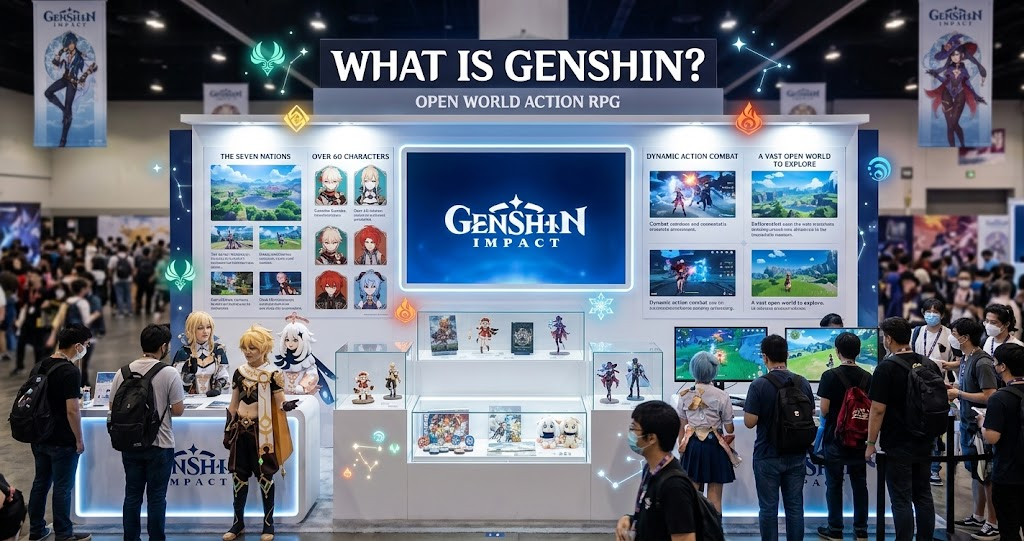
Genshin Impact is an open-world action RPG developed by HoYoverse. The game places players in Teyvat, a fantasy world divided into distinct regions, each with its own environments, characters, quests, enemies, and storylines.
The basic adventure loop is straightforward. You explore the world, complete quests, discover resources, fight enemies, solve environmental puzzles, and strengthen your characters. However, the systems underneath that simple loop give the game considerable depth.
Genshin is also designed around a party system. Instead of controlling only one character throughout an encounter, you can switch between members of your team and combine their abilities. As a result, understanding how characters interact becomes an important part of combat.
The official game continues to receive new regions, characters, events, quests, and gameplay systems. In September 2026, the official site highlighted Version 7.1 content and new characters, while the game also marked its sixth anniversary.
How Genshin Characters Work
Characters are at the heart of Genshin gameplay. Each playable character has an elemental type, a weapon type, unique abilities, and a role that can influence how they function within a team.
The seven standard elements are Pyro, Hydro, Anemo, Electro, Dendro, Cryo, and Geo. Characters use these elements through normal attacks, skills, bursts, and other mechanics. Combining different elements can create reactions that change how battles play out.
Weapon types also affect a character’s combat style. Swords generally provide close-range attacks, while claymores offer a heavier approach. Polearms provide another close-range option, whereas bows allow ranged attacks. Catalysts are closely connected to elemental damage.
A strong team does not necessarily require four characters that all perform the same job. Instead, players often combine damage dealers with characters that provide healing, shields, buffs, elemental application, or other forms of support.
The official character archive demonstrates how broad the roster has become, with characters connected to different regions, stories, elements, and weapon types.
Understanding Character Roles
A main damage dealer generally spends more time actively attacking opponents. Support characters, meanwhile, may spend less time on the field while providing effects that improve the team’s overall performance.
Sub-DPS characters can bridge these roles by contributing meaningful damage without needing constant field time. Healers and shielders can also provide valuable defensive support, especially when you are exploring unfamiliar areas or fighting difficult enemies.
For newer players, it is usually more useful to understand how a character fits into a team than to focus only on individual damage numbers. A character with abilities that complement the rest of your party can be extremely valuable.
Genshin Elements and Combat
Elemental combat is one of the defining features of Genshin. Rather than treating every attack as simple physical damage, the game encourages players to combine elemental effects.
For example, Hydro and Pyro can interact to create Vaporize, while Electro and Pyro can produce Overloaded. Other combinations involve Cryo, Dendro, Anemo, and Geo, creating different combat opportunities.
The important point is that elemental reactions depend on the characters and effects involved. Therefore, simply having powerful characters is not always enough. A team becomes more interesting when its abilities work together.
Players should also pay attention to enemy behavior. Some opponents have shields, resistances, special attacks, or mechanics that make particular approaches more effective. Switching characters at the right moment can therefore be more valuable than repeatedly attacking with one character.
Choosing a Team
When building a team, consider how each character contributes to the overall rotation. A damage dealer may need another character to apply an element consistently, while a support may provide healing or protection between attacks.
Energy management also matters because Elemental Bursts require energy. Characters that generate or use energy efficiently can make a team feel much smoother during longer encounters.
New players do not need to create a perfect team immediately. Instead, experiment with the characters available to you and learn which combinations feel comfortable.
Exploring the Genshin World
Exploration is one of the strongest parts of Genshin. Teyvat is designed to reward players who move beyond the main quest and investigate their surroundings.
While traveling, you can discover Teleport Waypoints, treasure chests, puzzles, hidden paths, quests, resources, domains, and other activities. Exploration progress can also become connected to regional systems and rewards.
The game’s exploration systems have expanded substantially over time. Official updates have introduced new areas alongside quests, fishing locations, reputation systems, and other regional activities.
The world is also designed around vertical movement. Climbing, gliding, swimming, and other traversal mechanics make the environment feel more interactive than a traditional map.
For that reason, exploration should not always be treated as something you do only when you need materials. Taking time to investigate unusual locations can lead to quests, puzzles, resources, and story details that are easy to miss when traveling directly between objectives.
Genshin Regions and Their Stories
The world of Teyvat is divided into regions with distinct cultures, landscapes, characters, and narratives. The journey has expanded considerably since the game’s launch, giving long-term players an increasingly large world to explore.
Earlier regions established the foundations of the story, while later regions introduced new mechanics, environments, and characters. Natlan, for example, added a region built around its own culture and traversal systems, while later content continued expanding the world.
By 2026, the journey had reached the northern lands connected with Snezhnaya and Nod-Krai. Official material describes Nod-Krai as a new area featuring places such as Lempo Isle, Hiisi Island, and Paha Isle, along with additional quests, fishing content, and domains.
The following table gives a simplified view of how major regions contribute to the overall adventure.
| Region | Main Theme | Exploration Feel | Story Role |
|---|---|---|---|
| Mondstadt | Freedom | Open plains and cliffs | Early-game foundation |
| Liyue | Contracts | Mountains and valleys | Expands the main story |
| Inazuma | Eternity | Islands and varied terrain | Focuses on isolation and change |
| Sumeru | Wisdom | Forests and desert | Adds major Dendro-focused systems |
| Natlan | War and competition | Diverse terrain | Introduces regional combat and traversal |
| Snezhnaya | Ice and Fatui | Northern landscapes | Connects to major ongoing mysteries |
| Nod-Krai | Moonlit northern frontier | Islands and rugged areas | Expands the northern storyline |
The key takeaway is that every region adds more than scenery. Each one combines environmental design with quests, characters, mechanics, and lore, making exploration part of the broader narrative.
Genshin Quests and Story Progression
Quests provide the main structure for the game’s narrative. Archon Quests focus on the central journey, while character and world quests provide additional stories around the people and locations of Teyvat.
For a new player, following the main story is a practical way to learn the game. The quests gradually introduce exploration, combat, characters, domains, and other systems without requiring you to understand everything at once.
World Quests are also worth paying attention to. Some provide background about locations or characters, while others unlock activities or reveal areas that are not obvious from the main storyline.
However, you do not need to rush through every quest. Genshin is designed as an ongoing adventure, so taking time to explore between major story chapters can make the world feel more connected.
How to Progress Efficiently in Genshin
Progression becomes more complicated as your account develops. Early on, simply improving characters and weapons can make a noticeable difference. Later, artifacts, talents, team rotations, and elemental interactions become increasingly important.
Adventure Rank acts as a broad progression system and unlocks access to additional content. Domains provide important materials, while quests and exploration can provide resources and rewards.
Resource management is especially important for newer players. Instead of spreading every material across a large roster, concentrating on a small group of characters can make progression more manageable.
You should also avoid upgrading equipment purely because it has a higher rarity. The usefulness of a weapon or artifact depends on the character using it and the role it serves.
Building Stronger Characters
Character level is only one part of progression. Talents can improve abilities, weapons affect damage and utility, and artifacts can significantly influence a character’s performance.
As your account grows, you can start paying closer attention to stats and artifact sets. However, beginners should not spend excessive time chasing perfect artifacts too early.
A practical approach is to build characters well enough to clear current content, then improve their equipment as your account becomes more developed. This avoids wasting valuable resources on tiny upgrades.
New Genshin Content Keeps the World Growing
One reason Genshin continues to feel different over time is its regular content cycle. New updates can introduce characters, locations, quests, events, weapons, domains, and system improvements.
The official Version 7.1 material available in September 2026 included new characters and ongoing content connected with the northern part of Teyvat. The official site also showed the game continuing its expansion after six years of releases.
This ongoing structure means that information about characters, builds, events, and locations can change. Therefore, players should check current official announcements when making decisions about new content.
[Outbound link suggestion: Link to the official Genshin Impact website for current version announcements and character information.]
[Outbound link suggestion: Link to HoYoverse’s official Genshin Impact news archive for update details and event notices.]
Is Genshin Worth Playing?
Whether Genshin is right for you depends on the type of experience you want. The game offers a large world, character-focused progression, real-time combat, exploration, and a long-running story.
Players who enjoy discovering new locations and experimenting with teams can find plenty to do. Meanwhile, people who prefer a more structured experience can focus on quests and combat rather than completing every exploration objective.
The main consideration is that Genshin is a live-service game. Its world and systems continue to change, so the experience for a new player today is much larger than it was at launch.
That can be exciting, but it can also feel overwhelming. Starting with the main story, learning elemental combat, and gradually developing a small group of characters is a sensible way to approach the game.
Conclusion
Genshin combines open-world exploration, elemental combat, character progression, and an expanding story into one long-running RPG experience. Its biggest strength is the way these systems connect, because exploring the world can lead to resources, quests, characters, and discoveries that improve your overall journey.
Whether you are starting from the beginning or returning after a long break, learning how characters, elements, regions, and progression work will make the adventure easier to understand. As the world continues to expand, there is always another location, quest, character, or story thread waiting to be discovered.
FAQs
What is Genshin?
Genshin Impact is an open-world action RPG from HoYoverse. Players explore Teyvat, complete quests, fight enemies, collect resources, and develop a team of playable characters with different elemental abilities and weapons.
Is Genshin free to play?
Yes. Genshin Impact uses a free-to-play model, so players can download and play the core game without purchasing it upfront. The game also contains optional systems for obtaining characters, weapons, and other resources.
How many elements are in Genshin?
Genshin has seven main elements: Pyro, Hydro, Anemo, Electro, Dendro, Cryo, and Geo. Characters are associated with these elements, and elemental interactions can create different effects during combat.
What should new Genshin players focus on first?
New players should focus on learning the combat system, following the main story, exploring nearby areas, and developing a manageable group of characters. It is usually better to build a few useful characters than spread resources across the entire roster.
Does Genshin still receive new content?
Yes. The game continues to receive updates with new characters, regions, quests, events, and gameplay additions. Official 2026 updates show that the world is still expanding, including content connected with Nod-Krai and the northern storyline.
For more updates visit: GAME ARENAX
