



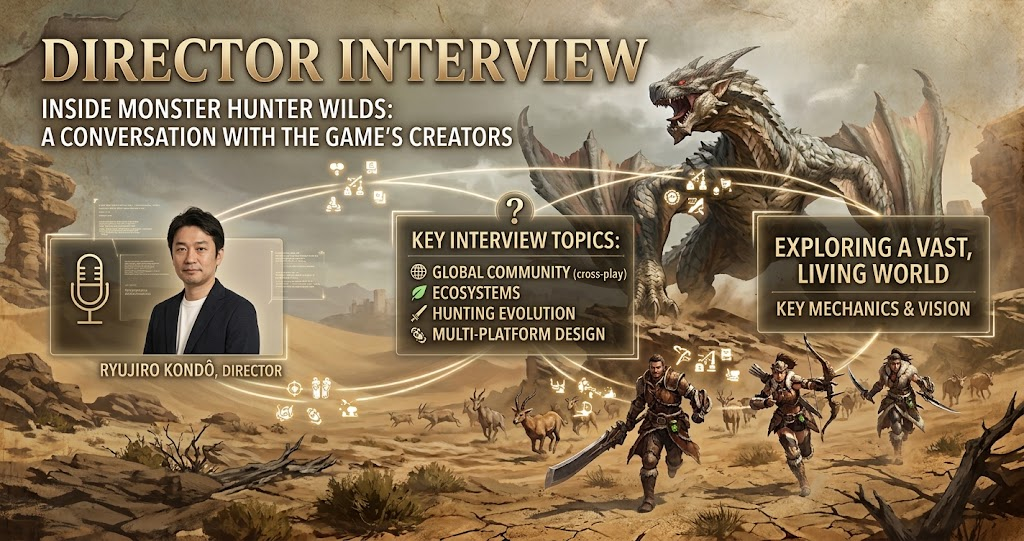
The Monster Hunter Wilds director interview reveals how Capcom approached combat, ecosystems, accessibility, and the long-term direction of the series. While Yuya Tokuda led the original game, Takuro Hiraoka now directs the upcoming Monster Hunter Wilds: Ascendance expansion.
That change makes the interviews especially interesting because they show two different stages of the same creative vision. Here is what the developers have said about Wilds, what they learned after launch, and how those lessons are shaping Ascendance.
What the Monster Hunter Wilds Director Interview Reveals
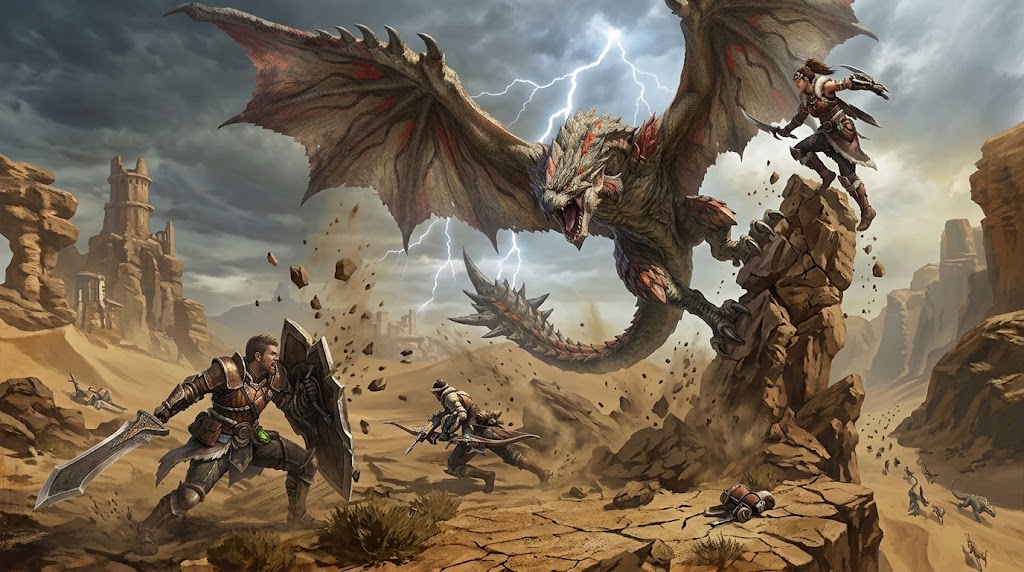
The original Monster Hunter Wilds director was Yuya Tokuda, who also directed Monster Hunter: World. During interviews before launch, Tokuda repeatedly emphasized the importance of making the game’s world feel like a living ecosystem rather than simply a collection of combat arenas.
That philosophy influenced almost every major system. Dynamic weather, monster interactions, changing environments, Focus Mode, wounds, and the Seikret all support a more connected hunting experience.
The goal was also to make the series easier to approach without removing the depth that experienced hunters expect. Interviews with Tokuda and producer Ryozo Tsujimoto highlighted how Wilds was designed to guide newcomers through its systems while preserving the strategic nature of Monster Hunter.
For returning players, however, accessibility was only part of the discussion. The developers wanted the new mechanics to create more possibilities without making the 14 weapon types feel interchangeable.
Yuya Tokuda’s Vision for Monster Hunter Wilds
Yuya Tokuda’s interviews provide important context for why Wilds feels more structured than some previous entries. He explained that the game’s story and ecosystem developed naturally from a central idea: humans should exist as part of the environment instead of standing outside it as observers.
That concept can be seen in how monsters interact with one another and how environmental conditions influence hunts. A sandstorm or other severe weather event is not simply visual decoration. The changing conditions can affect what appears in an area and how encounters develop.
Tokuda also discussed the evolution of the weapons. Rather than forcing every weapon toward the same counter-based design, Capcom wanted each weapon to follow its own path. The director explained that the team reviews all 14 weapon types with every new game and looks for ways to preserve their individual identities while improving their usefulness.
This approach helps explain why Wilds introduces mechanics such as Focus Mode without turning the entire combat system into a single formula.
Monster Hunter Wilds Combat Design and Focus Mode
Combat was one of the most discussed subjects in the original developer interviews. Wilds introduced Focus Mode as a way to give hunters greater control over attacks and positioning, particularly when targeting wounds on monsters.
The system does not simply function as a traditional lock-on feature. Instead, Focus Mode gives players more precise control over attacks and creates additional opportunities around vulnerable areas.
The developers also used the new system to address the three-dimensional nature of the environments. GamesRadar’s interview with Tokuda noted that weapon changes were often connected to gaps in individual movesets, including situations created by the greater verticality of the game’s maps.
That distinction matters because Capcom was not trying to make every weapon perform the same role. A mechanic could solve a particular weakness while still keeping the weapon’s personality intact.
The result is a combat system that builds on Monster Hunter’s traditional positioning and timing while giving hunters more direct control during encounters.
How the Developers Built a Living Ecosystem
The ecosystem was another major theme in the Monster Hunter Wilds interview coverage. Capcom wanted monsters to behave more naturally and react to the world around them.
That ambition required more than adding detailed environments. Developers studied animal behavior, nature documentaries, and real-world ecosystems when considering how creatures should move and interact. The Guardian reported that the team even drew inspiration from observing animals such as pet lizards while developing the game’s ecosystem.
The idea becomes particularly noticeable during monster encounters. Turf wars, pack behavior, environmental changes, and sudden weather events can make a hunt feel less predictable.
This also affects exploration. Instead of treating each location as a static backdrop, Wilds uses its environments to create situations that can change while the player is hunting.
Why Monster Hunter Wilds Was Designed for New Players
Monster Hunter has traditionally had a reputation for complicated systems and a demanding learning curve. The developers knew that Wilds had an opportunity to bring more people into the series.
Tokuda and Tsujimoto discussed tutorials, early guidance, and the overall pacing of the opening experience. The intention was to help newcomers understand hunting fundamentals before asking them to master more complicated systems.
However, accessibility did not mean removing complexity. Experienced hunters could still experiment with weapon combinations, positioning, monster behavior, equipment choices, and more advanced combat techniques.
This balance became important after release because players responded differently to the game’s difficulty. Later development discussions around Ascendance show that Capcom has been examining player feedback rather than treating the original balance as final.
What Changed After the Original Director’s Work
The biggest development story now involves Takuro Hiraoka. Capcom has confirmed that Hiraoka is directing Monster Hunter Wilds: Ascendance, taking over that role from Yuya Tokuda for the expansion. Hiraoka has a long history with the franchise and previously worked on projects including Monster Hunter World: Iceborne.
This does not mean the expansion abandons Tokuda’s ideas. Instead, Hiraoka has described Ascendance as a natural evolution of Wilds.
In a recent developer interview, Hiraoka explained that the team wanted to preserve elements that worked well while also improving areas where the developers and players saw room for change. He specifically connected the new Boost Bracer system to existing mechanics such as wounds and Focus Mode.
That makes the director transition less of a hard reset and more of a continuation.
Takuro Hiraoka’s Approach to Ascendance
Hiraoka brings a different development background to the expansion. Before taking the director role on Ascendance, he worked across Monster Hunter projects and later directed Exoprimal. He has described the new expansion as a mixture of experience gained from both Monster Hunter and his work outside the franchise.
His stated goal is particularly important for longtime players. Rather than simply adding more content, the team is reviewing the base game’s strengths and weaknesses and using that information to shape the expansion.
Recent interviews also indicate that Capcom is reassessing difficulty for the expansion’s endgame. Hiraoka said the development team had underestimated how quickly players would improve, leading to a renewed focus on creating satisfying challenges for experienced hunters.
Monster Hunter Wilds and Ascendance Compared
The following table shows how the original game’s direction connects with the expansion’s current development approach.
| Area | Monster Hunter Wilds | Ascendance |
|---|---|---|
| Director | Yuya Tokuda | Takuro Hiraoka |
| Core approach | New generation of hunting | Evolution of Wilds |
| Combat focus | Focus Mode and wounds | Boost Bracer system |
| World design | Dynamic ecosystems | New environments and ecosystems |
| Difficulty | Broader accessibility | Stronger endgame focus |
| Development goal | Expand the series | Refine and extend Wilds |
The key takeaway is that Ascendance is not positioned as a completely separate interpretation of Wilds. Instead, the developers are using the original game’s systems as a foundation and building new combat, environments, and challenges around them.
What the Latest Director Interview Says About Ascendance
The most recent interviews give players a clearer idea of where the expansion is heading. Monster Hunter Wilds: Ascendance introduces the Skybound Eyrie, a new environment featuring floating islands and ruins above the Forbidden Lands. The expansion also adds new actions for all 14 weapon types through the Boost Bracer.
The new location represents an interesting continuation of Capcom’s environmental philosophy. Because the Skybound Eyrie does not correspond directly to a real-world location, the developers had to create its ecology from a mixture of imagination and real botanical references.
The expansion also continues the game’s story while introducing new monsters and returning threats. Capcom has confirmed that Teostra returns, while later presentations have shown more of the expansion’s environments and encounters.
Another major point is player feedback. Hiraoka has said the team reviewed a wide range of responses to the base game and considered which changes could realistically improve the experience. That suggests the expansion is being shaped by both the developers’ original goals and what players experienced after launch.
Why the Director Change Matters
For fans searching for a Monster Hunter Wilds director interview, the distinction between Tokuda and Hiraoka is worth understanding.
Tokuda established the creative direction of the base game. His interviews focused heavily on ecosystems, accessibility, weapon identity, and making the world feel interconnected. Hiraoka, meanwhile, is taking those foundations and examining what can be expanded or refined.
That makes Ascendance an interesting test of Capcom’s development philosophy. The team is not simply adding a larger map or more monsters. It is trying to identify what made Wilds successful while responding to areas where the base game could have been stronger.
The approach also reflects how major Monster Hunter expansions traditionally work. They can become an opportunity to push combat depth and challenge while retaining the systems and world established by the original release.
For readers interested in the broader franchise, [read our guide to the latest Monster Hunter Wilds updates] and [explore our Monster Hunter game coverage] for more related information.
An authoritative source for official announcements is Capcom’s Monster Hunter news and developer-video coverage, while PlayStation’s official blog provides useful first-party interviews and feature coverage about the game’s development.
What These Interviews Tell Us About Monster Hunter’s Future
The interviews suggest that Capcom sees Monster Hunter Wilds as a foundation rather than a finished endpoint.
Tokuda’s work established a world where ecosystems, weather, monster behavior, and combat systems interact more closely. Hiraoka’s approach appears focused on taking those ideas further while addressing feedback from players.
The Boost Bracer is a good example. Instead of replacing Focus Mode or the wound system, the new mechanic builds on them. That approach allows the expansion to feel familiar while still giving experienced hunters something new to master.
The same philosophy applies to the world. The Skybound Eyrie expands the visual and environmental scope of Wilds, but the developers are still thinking about believable ecology and how creatures fit into their surroundings.
That consistency could become one of the expansion’s biggest strengths.
Conclusion
The Monster Hunter Wilds director interview story is really about evolution. Yuya Tokuda established the original game’s focus on ecosystems, accessible progression, and distinct combat systems, while Takuro Hiraoka is now carrying those ideas into Ascendance.
The expansion’s new environments, Boost Bracer mechanics, returning monsters, and renewed attention to difficulty show that Capcom is building directly on what players already know.
FAQs
Who was the director of Monster Hunter Wilds?
Yuya Tokuda directed the original Monster Hunter Wilds. He previously directed Monster Hunter: World. For the upcoming Monster Hunter Wilds: Ascendance expansion, Takuro Hiraoka has taken over as director.
Who is directing Monster Hunter Wilds Ascendance?
Takuro Hiraoka is directing Monster Hunter Wilds: Ascendance. He has extensive experience with the Monster Hunter series and previously worked on Monster Hunter World: Iceborne. His approach focuses on evolving the base game’s strengths while addressing areas that can improve.
What did Yuya Tokuda say about Monster Hunter Wilds?
Tokuda emphasized the importance of a living ecosystem, distinct weapon identities, and accessibility for new players. He also explained how systems such as Focus Mode were designed to give hunters more control while preserving the unique feel of each weapon.
What is Monster Hunter Wilds: Ascendance adding?
Ascendance adds a new story, the Skybound Eyrie, additional monsters, Master Rank content, and new weapon actions connected to the Boost Bracer. The expansion is scheduled for 2027.
Is Ascendance based on player feedback?
Yes. Takuro Hiraoka has said the development team reviewed player feedback and used it alongside internal observations to identify areas that could be improved. The expansion therefore aims to preserve successful Wilds mechanics while refining the overall experience.
For more updates visit: GAME ARENAX
