



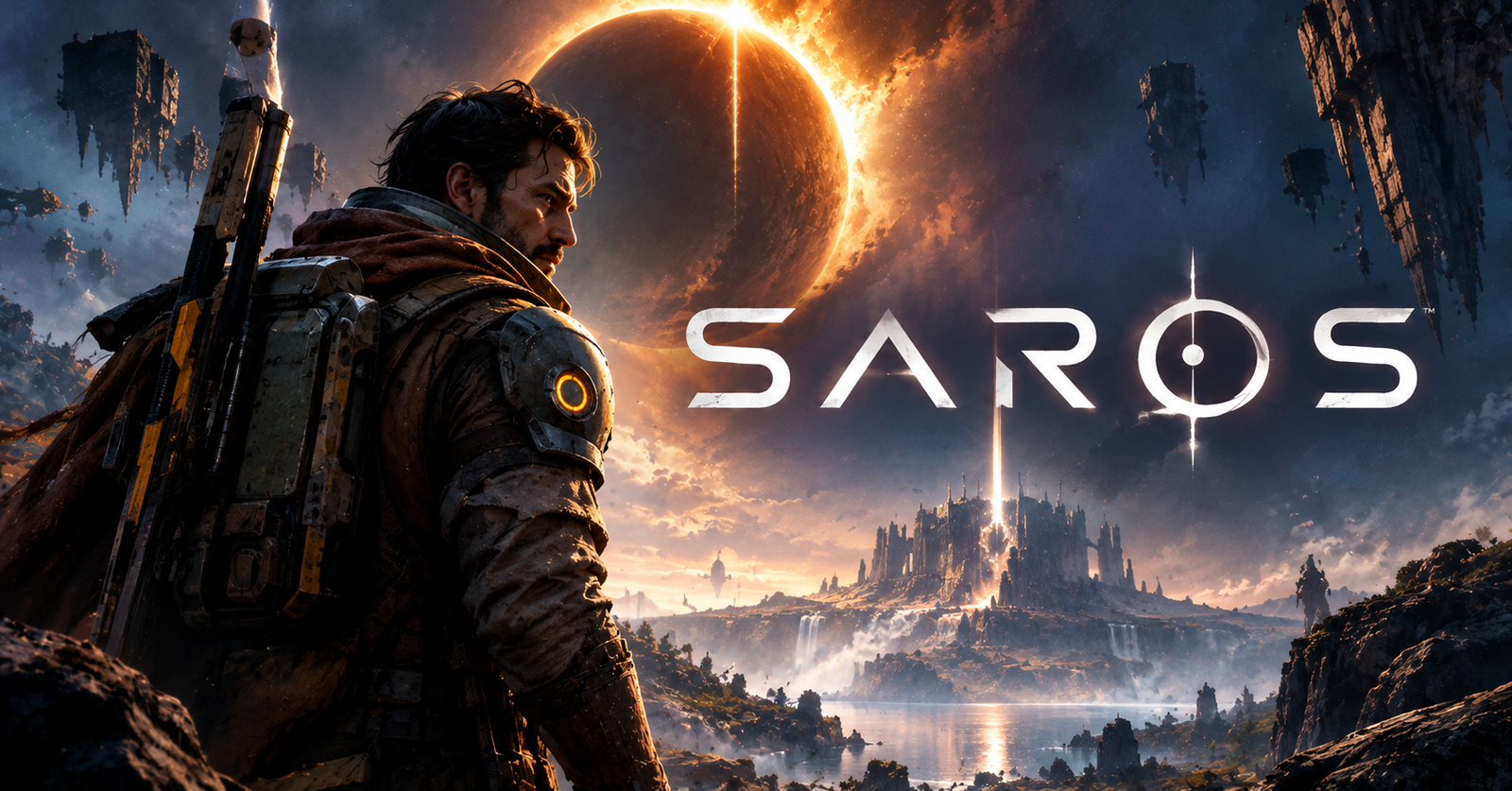
What happens when every defeat changes the world, but every attempt also makes you stronger? Saros turns that idea into a fast-paced science-fiction action adventure filled with hostile creatures, mysterious ruins, and intense projectile-based combat. Developed by Housemarque, the game builds on the studio’s experience with Returnal while introducing its own progression systems and haunting story.
Released on April 30, 2026, Saros is available exclusively on PlayStation 5, with enhancements for PS5 Pro. This guide explores its story, combat mechanics, permanent upgrades, changing environments, and key features so you can decide whether this challenging action game fits your gaming style.
What Is Saros?
Saros is a single-player, third-person action game developed by Housemarque and published by Sony Interactive Entertainment. The adventure takes place on Carcosa, a hostile alien world shaped by an approaching eclipse and the remains of a lost off-world colony.
Players control Arjun Devraj, a Soltari Enforcer searching for answers on the mysterious planet. Actor Rahul Kohli performs the character, helping bring a more personal story to the game’s intense action.
Unlike a conventional shooter with a fixed sequence of encounters, Saros emphasizes learning, adaptation, and repeated attempts. Enemies launch dangerous projectile patterns, environments change, and each run creates new challenges. However, defeat does not erase all your progress.
That balance between demanding combat and permanent character development is central to the experience. Players must improve their reactions while also making choices that help Arjun survive future encounters.
Saros Gameplay How Combat and Progression Work

The main attraction of Saros is its fast, projectile-focused combat. Enemies fill the screen with attacks, forcing players to watch their surroundings and respond quickly. Dodging, shielding, parrying, and selecting the right weapon all contribute to survival.
Bullet Ballet and Defensive Skills
Housemarque describes its combat style as a form of bullet ballet. Rather than simply firing continuously, players must move through complex attack patterns while looking for opportunities to strike back.
Dodging helps Arjun escape dangerous projectiles, while the shield provides another way to respond to incoming attacks. The parry mechanic adds a more precise defensive option because a correctly timed move can reflect certain projectiles toward enemies or stagger them.
These abilities reward timing and observation. For example, rushing toward an enemy without studying its attack pattern can leave Arjun exposed. Learning when to dodge, block, or parry makes encounters more manageable.
Weapons also influence how players approach each fight. A weapon that suits one encounter may feel less effective against another enemy, so adapting your strategy is often more useful than relying on a single tactic.
Why Permanent Progression Matters
Saros introduces permanent resources and upgrades that remain available after a failed run. Players can return to the Passage, a hub between expeditions, and invest in improvements to Arjun’s equipment and abilities.
This creates a different relationship with failure. Losing a difficult encounter can still contribute to long-term progress, even if you need another attempt to defeat a particular boss or reach a new area.
The game’s Second Chance system also gives players another opportunity to recover from a fatal mistake under its specific conditions. Together, these progression systems encourage experimentation without removing the need to master combat.
Saros Story and the Mystery of Carcosa
The story follows Arjun Devraj as he searches for someone on Carcosa, a planet filled with hostile life, ancient ruins, and unsettling secrets. An ominous eclipse influences the world, changing its environments and affecting the people connected to the lost colony.
Arjun’s journey is not only about surviving dangerous encounters. It also explores his motivations, his relationships with other characters, and the consequences of pursuing answers in an increasingly unstable place.
The Passage gives the narrative room to develop between runs. There, Arjun can interact with members of his crew and learn more about the people involved in the mission. As the eclipse spreads its influence, trust becomes harder to maintain, adding tension to the exploration.
Saros also uses atmosphere to strengthen its storytelling. Alien architecture, shifting landscapes, unusual creatures, and a dark electronic score make Carcosa feel threatening even when combat is not taking place.
Players who enjoy science-fiction mysteries may appreciate this approach. However, those who prefer a straightforward story with frequent explanations should expect some uncertainty as the game gradually reveals its secrets.
Saros Features at a Glance
The following table summarizes the main systems that shape the experience.
| Feature | How It Works | Gameplay Benefit |
|---|---|---|
| Changing world | Carcosa shifts between runs | Encourages adaptation |
| Permanent upgrades | Resources support lasting improvements | Makes progress meaningful |
| Bullet ballet combat | Dodge and respond to projectile attacks | Rewards timing and awareness |
| Parry system | Reflect certain projectiles with precise timing | Creates defensive openings |
| Second Chance | Offers a recovery opportunity under specific conditions | Can save a difficult run |
| Carcosan Modifiers | Adjust selected gameplay conditions | Supports a more tailored challenge |
These systems work together rather than functioning as isolated additions. The changing environment tests your ability to adapt, while permanent upgrades help you prepare for the next attempt. As a result, success depends on both combat skill and smart long-term decisions.
How the Eclipse Changes Saros Gameplay
The eclipse is more than a visual effect. It plays an important role in the world’s atmosphere and gameplay, influencing the environments players explore and the threats they face.
As the world changes, familiar areas can offer different routes, encounters, and opportunities. This encourages players to remain alert instead of assuming that a previously successful strategy will always work in the same way.
The eclipse also contributes to the game’s sense of danger. Its corrupting influence affects the planet and its inhabitants, creating a connection between the story and the combat systems.
This design gives repeated runs a narrative purpose. Arjun is not simply repeating the same mission without context. Instead, each attempt takes place within a world that continues to evolve as he uncovers more of Carcosa’s mysteries.
Saros on PS5 and PS5 Pro
Saros was built for PlayStation 5 and is enhanced for PlayStation 5 Pro. The game uses the console’s hardware to support fast loading, detailed environments, and responsive combat.
The DualSense controller also contributes to the experience through haptic feedback and adaptive triggers. These features help communicate the feel of Arjun’s weapons and suit, adding another layer of feedback during intense encounters.
Audio plays an important role as well. The game’s atmospheric sound design and electronic score help establish the mood of Carcosa, while directional sound can support awareness during combat.
Accessibility options include color-blindness features, dialogue focus mode, and controller remapping. These options give players more control over how they experience the game, although the best configuration will depend on individual needs.
At launch, Saros was offered in Standard and Digital Deluxe editions. The Deluxe Edition includes additional content, including special Enforcer suits inspired by other PlayStation games. Check the official PlayStation Store listing for current regional prices and the exact contents of each edition.
Is Saros Similar to Returnal?
Saros and Returnal share several design principles. Both feature fast third-person combat, challenging enemies, science-fiction environments, and gameplay built around repeated attempts. Housemarque’s focus on responsive movement and dense projectile patterns is also recognizable in both games.
However, Saros places greater emphasis on permanent resources and direct character upgrades. This gives players more ways to strengthen Arjun between runs and creates a clearer sense of lasting progress after defeat.
The games also tell different stories in distinct worlds. Returnal follows Selene through the alien planet Atropos, while Saros centers on Arjun and the mysteries of Carcosa. Therefore, familiarity with Returnal can help players understand the combat style, but it is not necessary to follow Saros.
If you enjoy difficult action games, both are worth considering. You can also explore [our Returnal gameplay guide] or [our best PS5 action games roundup] to find more experiences with demanding combat.
Is Saros Worth Playing?
Saros is a strong option for players who enjoy challenging combat, atmospheric science fiction, and progression that rewards repeated attempts. Its combination of dodging, shielding, parrying, and permanent upgrades offers several ways to approach difficult encounters.
The game also suits players who enjoy discovering a story through exploration and environmental details. Carcosa’s changing landscapes help maintain a sense of uncertainty, while the Passage provides a place to regroup and learn more about the characters.
However, the demanding combat may not appeal to everyone. Players who prefer relaxed exploration or uncomplicated action may find the projectile patterns and boss encounters frustrating at times. Although permanent progression can make future runs easier, it does not remove the need to learn enemy behavior.
For reliable updates, consult Housemarque’s official news page and the official PlayStation game listing. These sources provide information about game features, patches, editions, and other confirmed details. You can also read [our guide to upcoming PlayStation games] for more console gaming coverage.
Conclusion
Saros combines fast-paced projectile combat, permanent upgrades, and a mysterious science-fiction story into a distinctive PlayStation action experience. Its shifting world keeps encounters unpredictable, while the progression systems help make each attempt worthwhile.
The game is especially appealing to players who enjoy mastering difficult fights and uncovering a layered narrative. If you own a PS5 and want a challenging new action adventure, explore the official game details and decide whether Saros fits your gaming preferences.
FAQs
When was Saros released?
Saros launched on April 30, 2026. Housemarque developed the game for PlayStation 5, with enhancements for PS5 Pro. Players can find the Standard and Digital Deluxe editions through the PlayStation Store, although current pricing and availability may vary by region.
Is Saros a sequel to Returnal?
No. Saros is a new intellectual property rather than a direct sequel to Returnal. Both games share Housemarque’s focus on demanding third-person action and projectile-heavy combat, but Saros features a different protagonist, setting, story, and progression approach.
Is Saros available on PC or Xbox?
Saros launched as a PlayStation 5 exclusive, with enhancements for PS5 Pro. There is no need to assume that a PC or Xbox version exists simply because other PlayStation titles have reached additional platforms. Check official announcements for any future platform updates.
Does Saros have permanent upgrades?
Yes. Saros lets players collect permanent resources and improve Arjun’s equipment and abilities between runs. These upgrades make each attempt contribute to longer-term progress. However, players still need to learn enemy patterns and use their combat abilities effectively to overcome difficult encounters.
Is Saros a single-player game?
Yes. Saros is designed as a single-player action adventure. Players control Arjun Devraj as he explores Carcosa, fights hostile creatures, and uncovers the story of the lost colony. Its focus is on individual progression and combat mastery rather than competitive or cooperative multiplayer.
For more updates visit: GAME ARENAX
