



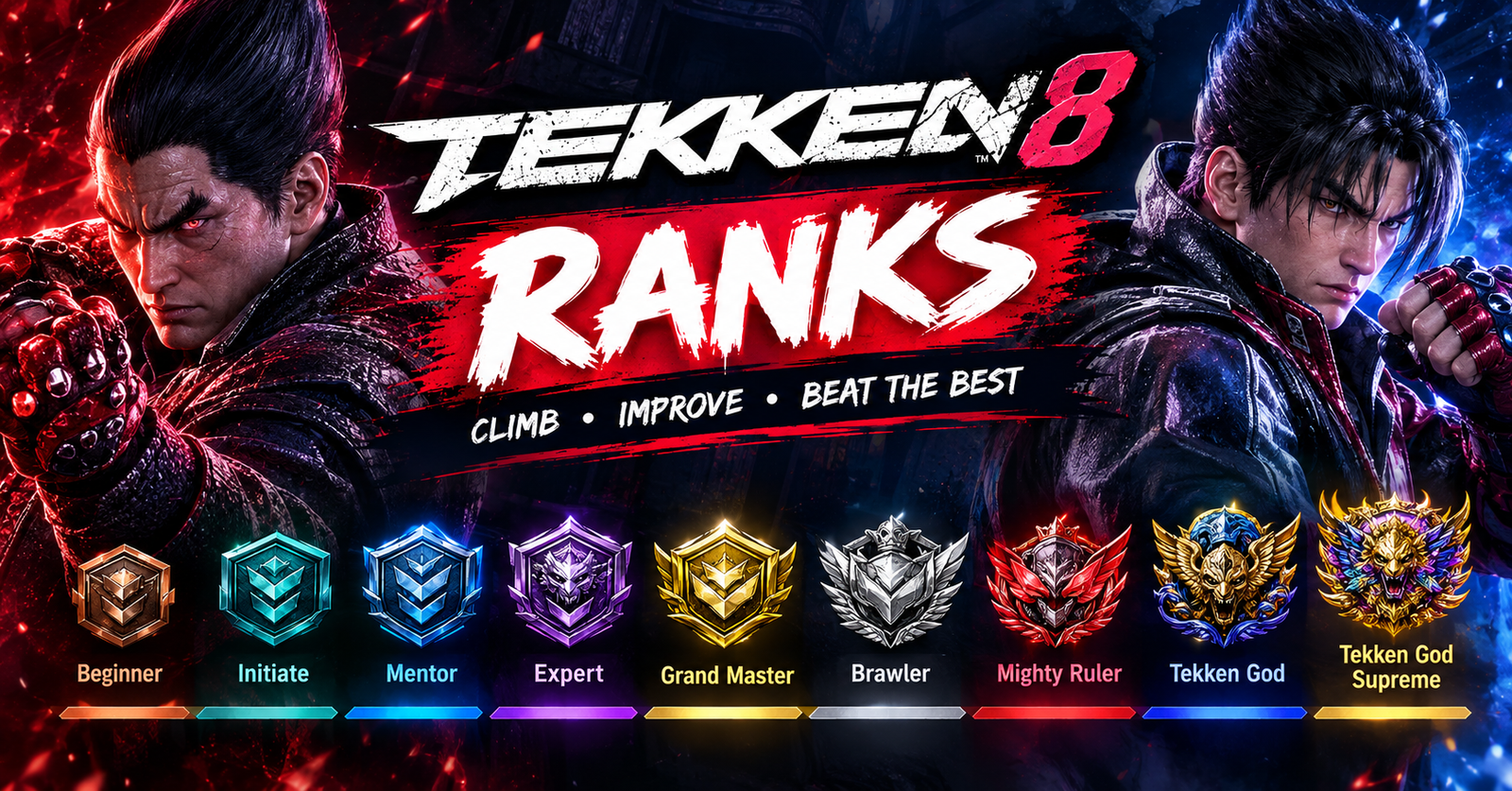
Climbing the competitive ladder in Tekken 8 takes more than landing powerful combos. You need consistent defense, smart movement, matchup knowledge, and a clear understanding of how the ranking system works. This guide explains Tekken 8 ranks in order, the different rank tiers, how promotion points work, and practical ways to improve your position in ranked matches.
Tekken 8 Ranks Explained
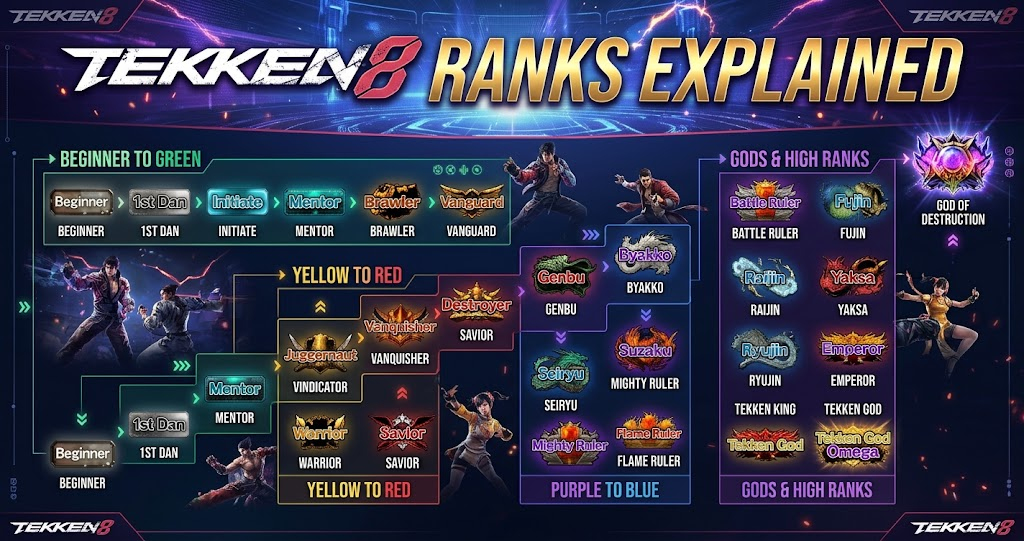
Tekken 8 uses a ranked progression system that matches players for competitive online battles. Wins and losses affect your rank points, and reaching the required threshold can qualify you for promotion. However, your next rank is not guaranteed until you win the required promotion match.
The ranking system starts with Beginner and progresses through several colored divisions before reaching the highest ranks. Each division represents another stage of the competitive climb, although rank alone cannot tell the full story of a player’s skill.
The game also tracks ranks by character. Therefore, your progress with one fighter does not necessarily mean you have the same rank with every character you use. This is especially important if you want to experiment with new fighters without losing sight of your main character’s progress.
Bandai Namco’s official ranked-mode information explains the basic system, while its Season 3 update notes describe adjustments to matchmaking and rank points. You can review the official Tekken 8 ranked-mode information for further details.
All Tekken 8 Ranks in Order
The rank names below follow the current Season 3 progression structure. The exact point thresholds and promotion rules can change with updates, so check the latest patch notes before relying on older rank charts.
| Rank Tier | Rank Names | Division Color | General Progress |
|---|---|---|---|
| Beginner | Beginner, 1st Dan, 2nd Dan | Early ranks | Learning the basics |
| Fighter Tier | Fighter, Strategist, Combatant | Light blue | Building fundamentals |
| Brawler Tier | Brawler, Ranger, Cavalry | Green | Improving consistency |
| Warrior Tier | Warrior, Assailant, Dominator | Yellow | Developing match strategy |
| Vanquisher Tier | Vanquisher, Destroyer, Eliminator | Orange | Refining execution |
| Dragon Tier | Garyu, Shinryu, Tenryu | Red | Strengthening competitive play |
| Ruler Tier | Mighty Ruler, Flame Ruler, Battle Ruler | Purple | Improving matchup knowledge |
| High Ranks | Fujin, Raijin, Kishin, Bushin | Blue | Facing tougher competition |
| God Ranks | Tekken King, Tekken Emperor, Tekken God, Tekken God Supreme | Gold | Advanced competitive play |
| Highest Ranks | God of Destruction and its numbered tiers through Infinity | God of Destruction | Top-end progression |
The table groups the ranks into useful stages rather than presenting every individual rank as a separate row. God of Destruction has additional progression levels, ending with God of Destruction Infinity, also known as Ouroboros. The official Season 3 patch notes should be your reference for changes to point thresholds and promotion rules.
How the Tekken 8 Ranking System Works
Rank Points and Promotions
Rank points determine your progress toward the next tier. Winning matches generally earns points, while losing matches can reduce your total. Once you meet the relevant promotion requirements, you must win the promotion match to advance.
The amount you gain or lose depends on the ranking rules in effect. In Season 3, Bandai Namco adjusted point thresholds and point gains and losses to improve competitive fairness. Promotion bonuses also became part of the revised system.
This means older guides may show point values that no longer match the live game. Rather than assuming every victory awards the same amount, check your post-match screen and pay attention to the difference between the points gained and the points lost.
Can You Lose Your Rank?
Demotion depends on your current rank and the rules for that division. The system does not treat every tier in the same way, so a player near a promotion or demotion threshold should pay attention to the in-game rank display.
It is also worth remembering that a losing streak does not automatically mean your overall skill has disappeared. Sometimes you face a difficult matchup, struggle with a particular opponent, or make repeated mistakes under pressure. Review what happened before deciding that your character or strategy needs a complete overhaul.
What Makes Each Rank Tier Difficult?
Beginner to Orange Ranks
The early divisions are where players develop their core habits. Learning basic movement, blocking, punishment, and reliable attacks is more valuable than memorizing a long combo that rarely connects.
As you progress through green, yellow, and orange ranks, opponents may begin punishing unsafe moves more consistently. Consequently, careless attacks can become a major obstacle. Focus on understanding when your character can safely attack and when it is better to defend.
Red and Purple Ranks
Garyu, Shinryu, and Tenryu mark the red division, followed by the purple Ruler ranks. At this stage, players benefit from more deliberate decision-making. Simply attacking more often is unlikely to solve every problem.
Instead, observe your opponent’s habits. If they frequently use the same approach, learn how to defend against it and respond with a reliable punish. Similarly, avoid repeating a risky move after your opponent has demonstrated that they can counter it.
Blue and God Ranks
The blue ranks and the upper God divisions demand stronger consistency. Players at these levels often understand their characters well, so small mistakes can have a greater impact on a match.
For example, poor spacing can leave you open to a punish, while predictable pressure gives an opponent an opportunity to defend effectively. Improving your matchup knowledge and choosing safer options can therefore matter as much as improving combo damage.
How to Rank Up Faster in Tekken 8
The most reliable way to climb is to improve the habits that repeatedly cost you matches. Start by identifying the mistakes that occur most often. You might be using unsafe attacks, failing to punish obvious openings, or pressing buttons when you should be blocking.
Practice mode can help you address these problems. Set up a situation that gives you trouble, then experiment with different defensive responses and punish options. Even a short practice session can be useful when you focus on one specific weakness rather than trying to learn everything at once.
It also helps to narrow your character choices while learning. Switching fighters frequently can be enjoyable, but it may slow your progress if you are still learning basic moves and matchup interactions. Spend time understanding your main character’s reliable attacks, defensive options, and punish tools.
Finally, take breaks when frustration begins affecting your decisions. Repeated matches while tilted can reinforce bad habits. A short pause gives you time to review your performance and return with a clearer plan.
Tekken 8 Ranked Mode vs. Quick Match
Ranked Match and Quick Match serve different purposes. Ranked Match changes your competitive rank through wins and losses, while Quick Match lets you play without affecting that rank. This makes Quick Match useful when you want to practice a new character or test a strategy without putting your current progress at stake.
Player Match offers another option for setting up sessions with friends or other players. Meanwhile, the game’s leaderboards let you compare competitive results through measures such as ranking points, Tekken Power, and ranked wins.
Choosing the right mode can make your practice more effective. Use ranked matches to test your competitive consistency, then switch to a more relaxed mode when you want to experiment or work on unfamiliar matchups.
Common Mistakes That Slow Rank Progress
One common mistake is focusing only on combos. High-damage combos can help you win rounds, but they do not replace movement, defense, spacing, and punishment. A player who understands when to attack may perform better than someone who knows a complicated combo but struggles to create an opening.
Another problem is refusing to adapt. If an opponent repeatedly catches you with the same move, continuing the same approach will probably produce the same result. Watch replays when possible and look for patterns in your losses.
Players can also become too concerned with the rank badge itself. Your rank provides a useful measure of progress, but it does not explain every weakness or strength. Concentrating on one improvement at a time often produces better long-term results than chasing points in every session.
Conclusion
Understanding Tekken 8 ranks makes the competitive climb easier to follow, from the early divisions through the highest God tiers. Rank points, promotion matches, character-specific progression, and seasonal adjustments all influence your journey.
To improve, focus on fundamentals, study difficult matchups, and use practice mode to correct recurring mistakes. Check the latest official patch notes whenever you need current point rules. With a consistent approach, you can make better decisions in ranked matches and work toward your next promotion.
FAQs
What is the highest rank in Tekken 8?
The highest rank progression includes God of Destruction Infinity, also called Ouroboros. Reaching the upper God ranks requires substantial consistency and strong matchup knowledge. Since the game can receive ranking-system updates, check the latest official patch notes for any changes to progression.
How many ranks are in Tekken 8?
Tekken 8 has a main progression from Beginner through the standard God ranks, followed by additional God of Destruction tiers. The expanded upper ranks include numbered levels and Infinity. For the current rank structure, consult a recent rank chart alongside the official update notes.
Does Tekken 8 rank depend on your character?
Yes, Tekken 8 tracks ranked progression by character. Your progress with one fighter does not necessarily represent your current rank with another. Rank inheritance and recalculation rules have changed across seasons, so review the latest official notes if you plan to switch mains.
Do losses remove rank points in Tekken 8?
Yes, ranked losses can reduce your points, depending on the current ranking rules and your rank. The game adjusts points based on the competitive system in effect. Check the post-match display to understand how much you gained or lost after each battle.
What is the best way to rank up in Tekken 8?
Focus on reliable defense, movement, punishment, and learning your character’s strongest tools. Practice the situations that repeatedly cause trouble, and review replays to identify avoidable mistakes. Consistent improvement usually offers a more sustainable path than relying on risky attacks or chasing short winning streaks.
For more updates visit: GAME ARENAX
