



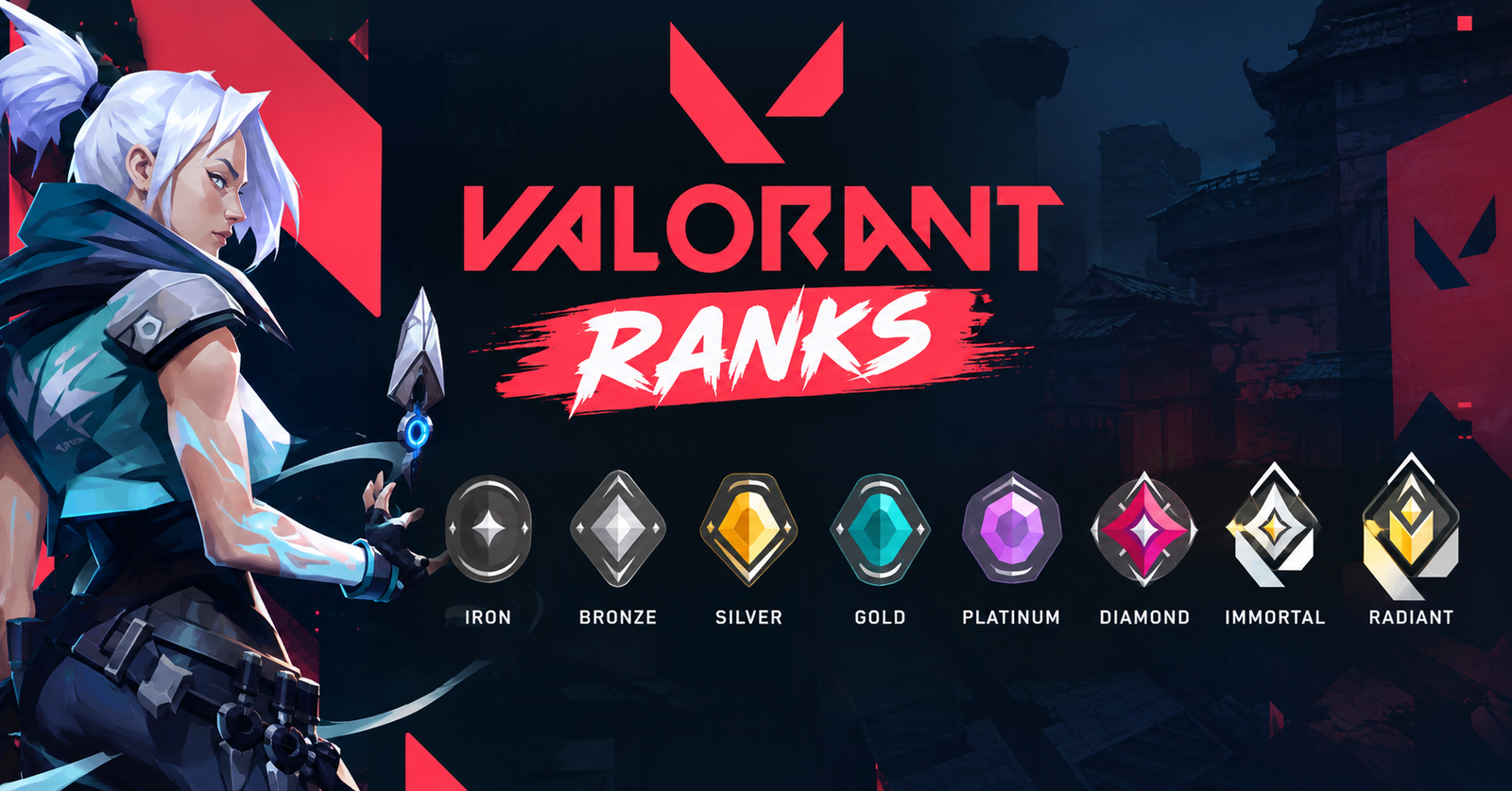
Understanding VALORANT ranks is essential if you want to improve in Competitive mode. Whether you are starting in Iron or trying to reach Radiant, the ranking system shows how your competitive progress compares with other players.
The system is more than a simple ladder. Your rank is connected to Rank Rating, matchmaking, hidden MMR, placement matches, and the results of your games. This guide explains how VALORANT ranks work, what each tier means, how RR affects your climb, and what you can do to make better progress.
How VALORANT Ranks Work
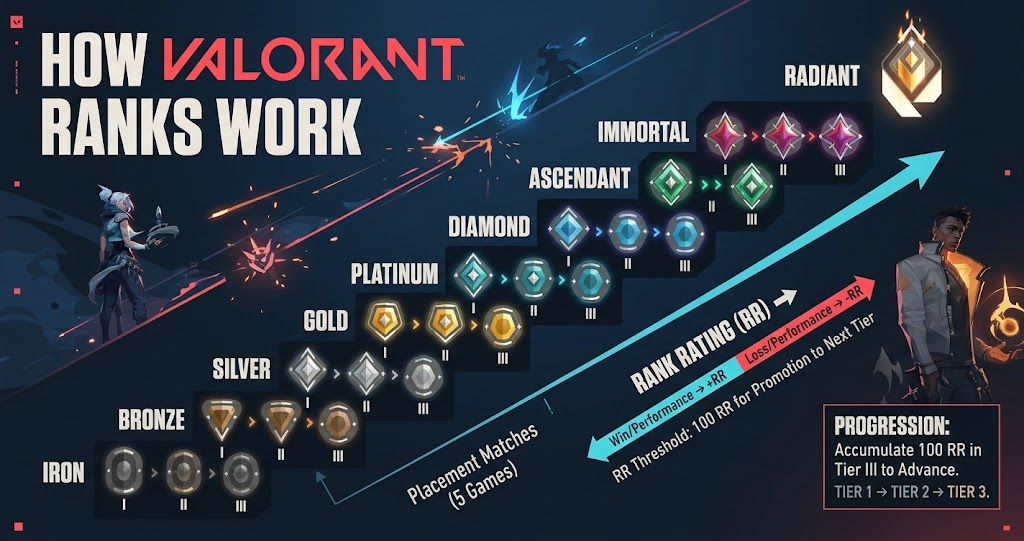
VALORANT uses a tiered competitive Ranking system that begins with Iron and progresses through Bronze, Silver, Gold, Platinum, Diamond, Ascendant, Immortal, and Radiant. Most ranks contain three tiers, while Radiant sits at the top of the competitive ladder.
Riot Games introduced Ascendant between Diamond and Immortal to create more separation between different skill levels. The current structure therefore gives players more meaningful milestones as they improve.
Your displayed rank does not tell the entire story, however. Matchmaking also uses hidden MMR to help determine the level of opponents and teammates you encounter. Riot has continued adjusting the relationship between MMR and Ranked Rating to make competitive progression more consistent.
[Internal link suggestion: Learn more with anchor text “VALORANT competitive guide”]
VALORANT Ranks in Order
The VALORANT rank ladder starts with Iron and moves upward through Bronze, Silver, Gold, Platinum, Diamond, Ascendant, Immortal, and finally Radiant. Iron through Ascendant each have three tiers, while Immortal is divided into Immortal 1, Immortal 2, and Immortal 3.
The lower and middle ranks are designed to show gradual improvement. Moving from Silver to Gold, for example, represents a meaningful step in consistency, game knowledge, aim, positioning, and decision-making.
Immortal and Radiant work differently because they represent the upper end of the competitive population. At these levels, players compete for leaderboard positions rather than simply treating the system as a straightforward progression ladder.
| Rank | Tiers | Competitive Level | Progression Focus |
|---|---|---|---|
| Iron | 1 to 3 | Beginner | Fundamentals |
| Bronze | 1 to 3 | Developing | Consistency |
| Silver | 1 to 3 | Developing | Mechanics and decisions |
| Gold | 1 to 3 | Intermediate | Team play |
| Platinum | 1 to 3 | Advanced | Consistency under pressure |
| Diamond | 1 to 3 | High | Tactical execution |
| Ascendant | 1 to 3 | Very High | Strong fundamentals |
| Immortal | 1 to 3 | Elite | Competitive consistency |
| Radiant | Leaderboard | Highest | Top-level performance |
The key takeaway is that every rank represents more than aim alone. As you move higher, positioning, communication, utility usage, adaptation, and consistency become increasingly important.
Understanding VALORANT Rank Rating
Rank Rating, commonly called RR, is the visible progression system used across much of the competitive ladder. It shows how close you are to moving into the next rank or tier.
For players from Iron through Ascendant, Riot’s support documentation explains that reaching 100 RR normally results in promotion. After promotion, players begin the new tier with a small RR buffer. Losing at 0 RR can eventually result in demotion.
Winning is the most important factor in gaining RR. However, the amount you gain or lose can vary because the system considers your MMR and how your current rank compares with your underlying matchmaking rating.
For example, if your MMR indicates that you should be playing above your current rank, the system can give you stronger RR gains when you win. Conversely, if your displayed rank is above the level suggested by your MMR, your progression can feel slower.
That is why two players in the same rank may receive different RR results after similar matches.
How MMR Affects VALORANT Ranks
MMR is a hidden matchmaking measurement that helps the game estimate your skill level. Unlike your visible rank, you cannot simply open your profile and see your exact MMR.
The important relationship is between your MMR and your displayed rank. When those two values are close, your RR gains and losses tend to become more balanced. When they are further apart, the system can use RR gains or losses to move your rank toward the level it believes better represents your performance.
Riot has repeatedly adjusted this system. In 2026, the developer made further RR and matchmaking changes designed to improve rank consistency and reduce situations where players feel stuck despite consistently winning.
[Internal link suggestion: Use anchor text “VALORANT matchmaking explained” for a related guide]
VALORANT Placement Matches Explained
Placement matches help determine your starting competitive rank when you enter a new Episode or otherwise need to establish your rank.
The number and effect of placement matches can depend on your competitive status and the current competitive period. Riot’s ranking documentation has historically used five placement matches for players establishing an initial rank in an Episode, while returning players who have already placed can have different requirements when a new Act begins.
Your performance during placements matters, but you should not treat one match as a complete measurement of your ability. Competitive systems use matchmaking data accumulated over time, so consistent performance remains more important than one exceptional or disappointing game.
A better approach is to focus on playing your normal game. Avoid experimenting with unfamiliar agents, roles, or strategies simply because you want to impress the placement system.
What Each VALORANT Rank Says About Your Progress
Iron and Bronze
Iron and Bronze are where players generally build their competitive fundamentals. Aim control, movement, crosshair placement, basic ability usage, and understanding of the economy can make a major difference here.
Players in these ranks often gain more from learning reliable habits than from complicated strategies. Improving how you clear angles, avoid unnecessary deaths, and play around the Spike can create immediate benefits.
Silver and Gold
Silver and Gold require greater consistency. Mechanical skill still matters, but decision-making becomes increasingly important because opponents are more likely to punish predictable plays.
Gold players who want to continue climbing should start thinking about trading teammates, controlling space, managing utility, and adapting to enemy tendencies. Communication also becomes more valuable as matches become closer.
Platinum and Diamond
Platinum and Diamond represent a significant competitive step. Players usually have stronger mechanics and a better understanding of common strategies, so small mistakes can have a bigger impact.
At this stage, simply getting more kills is not always the answer. Better timing, utility coordination, positioning, and information gathering can turn close rounds into wins.
Ascendant
Ascendant sits above Diamond and below Immortal. Riot introduced the rank to create additional separation within the upper portion of the competitive ladder.
Players at this level generally need more than solid fundamentals. Consistency across entire matches becomes critical because opponents can punish repeated mistakes quickly.
Immortal
Immortal is one of the highest major rank groups in VALORANT. It contains Immortal 1, Immortal 2, and Immortal 3, with competitive progression increasingly tied to leaderboard positioning and regional requirements.
Riot has continued to adjust RR thresholds for Immortal 2, Immortal 3, and Radiant to account for regional differences.
Radiant
Radiant is the highest competitive rank in VALORANT. Unlike lower ranks, reaching Radiant depends on meeting the required competitive conditions for your region and earning a position among the top players.
Riot has historically required players to meet both a regional RR threshold and a top-500 regional leaderboard requirement. The exact competitive requirements can change, so players should check Riot’s latest Competitive information before treating older threshold figures as permanent.
How to Rank Up in VALORANT
The most reliable way to improve your VALORANT rank is to focus on winning more consistently rather than chasing individual statistics.
A player who understands when to take a fight can often provide more value than someone who constantly searches for kills. Good positioning gives you safer opportunities, while effective utility can make fights easier for your entire team.
Your agent choice should also support your strengths. If you enjoy creating opportunities for teammates, an Initiator or Controller may suit you. If you prefer holding sites and controlling space, a Sentinel can provide a better fit.
Another important factor is avoiding unnecessary tilt. A losing streak can encourage players to change everything about their gameplay, but that often creates even more inconsistency. Take a short break when your decision-making starts to deteriorate, then return with a clear plan.
Why Your VALORANT Rank Can Feel Stuck
A rank plateau does not always mean the ranking system is preventing you from climbing. Often, it means your current habits are producing results that match your existing rank.
For example, a player may have excellent aim but poor positioning. Another player may communicate well but take too many unnecessary fights. Someone else may understand tactics but struggle to maintain focus throughout a full match.
The solution is to identify the specific habit limiting your results. Review your deaths, missed opportunities, utility usage, and round decisions instead of looking only at your final kill count.
Riot has also made changes to matchmaking and RR calculations to improve consistency between players’ ranks and the level of matches they play.
VALORANT Ranks and Competitive Matchmaking
Competitive matchmaking aims to create balanced games based on player skill. Riot has continued refining matchmaking so teams with similar average ranks are more consistently matched against each other.
Patch 13.00 introduced a change intended to keep the average rank of each team within one sub-tier more often. For example, a team with an average rank around Gold 2 should more frequently face another team around the same general range.
This does not mean every player in a match will have exactly the same rank. Team composition, matchmaking data, queue conditions, and other factors can affect the final lobby.
The result is that your visible rank should be viewed as one part of a larger competitive system.
Rank Shields and Demotion Protection
VALORANT has also introduced Rank Shields to provide limited protection against immediate demotion. Riot added two Rank Shields for players at Tier 1 with 0 RR in eligible ranks, excluding Radiant.
This system can make the transition between ranks less punishing. However, Rank Shields should not be treated as a replacement for consistent performance.
The best way to protect your rank remains improving the quality of your matches. Stronger fundamentals can help you win more rounds without relying on protection systems.
How to Improve Your VALORANT Rank Consistently
Improvement becomes easier when you focus on a small number of repeatable habits. Warm up before Competitive if your mechanics feel inconsistent, and use practice sessions to work on a specific weakness rather than simply playing without a goal.
During matches, pay attention to why rounds are being lost. If you repeatedly die while entering a site, consider whether your timing, utility, positioning, or communication needs work.
You should also review your performance after difficult games. A loss can provide useful information, especially when you can identify the same mistake appearing across multiple rounds.
Most importantly, avoid judging your skill from one match. VALORANT ranks measure competitive progress over many games, so patience and consistency matter.
Where to Check Current VALORANT Rank Information
Because Riot can change RR calculations, matchmaking rules, placement requirements, and leaderboard conditions, older guides may eventually contain outdated information.
For the most authoritative information, use Riot Games’ official VALORANT patch notes when a competitive update is released. You can also check Riot’s official VALORANT Support documentation for explanations of Rank Rating and competitive progression.
Conclusion
Understanding VALORANT ranks makes the Competitive grind easier to approach because you can see what your rank represents and how RR fits into your progression. The ladder moves from Iron through Bronze, Silver, Gold, Platinum, Diamond, Ascendant, and Immortal before reaching Radiant.
However, climbing is not only about getting more kills. Strong positioning, smart decisions, useful communication, efficient utility, and consistent performances all contribute to winning more matches.
If your current VALORANT rank feels stuck, focus on one weakness at a time and measure your improvement over several games. Keep learning, avoid unnecessary tilt, and let consistent performance drive your climb.
FAQs
What are the VALORANT ranks in order?
The VALORANT ranks progress from Iron to Bronze, Silver, Gold, Platinum, Diamond, Ascendant, Immortal, and Radiant. Most ranks contain three tiers. Radiant is the highest rank and uses regional leaderboard requirements rather than the same tier structure used throughout the lower and middle ranks.
How does RR work in VALORANT?
Rank Rating, or RR, tracks your competitive progress. Players from Iron through Ascendant generally need to reach 100 RR to promote to the next tier. Match wins and losses are the biggest factors, while your hidden MMR also influences how much RR you gain or lose.
What is the highest VALORANT rank?
Radiant is the highest VALORANT rank. It is reserved for the strongest competitive players in each region. Reaching Radiant requires meeting the applicable regional RR requirement and securing the necessary leaderboard position, so the exact conditions can vary as Riot updates the competitive system.
Why am I gaining less RR than I lose?
Your RR gains and losses can be affected by the relationship between your visible rank and hidden MMR. If your MMR suggests that your current rank is higher than your expected skill level, your wins may provide less RR while losses can cost more. Consistent wins can help correct that gap.
How can I rank up faster in VALORANT?
The most reliable approach is to improve consistency rather than chase quick RR. Focus on winning rounds, reducing unnecessary deaths, using abilities effectively, communicating with teammates, and reviewing repeated mistakes. Better decision-making combined with solid mechanics will usually produce more sustainable progress than simply playing more matches.
For more updates visit: GAME ARENA
